
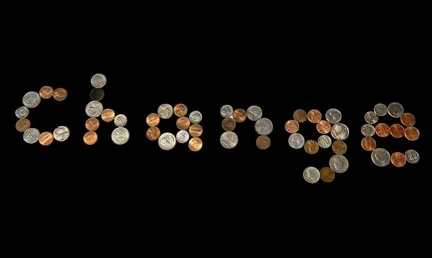
Being Okay With Change
Change is everywhere, whether we recognize it or not.
Day turns into night, flowers bloom and wither, stocks rise and fall. We move houses, change jobs, meet new people, and shift our mindsets.
Change is a natural part of life but sometimes, especially in our intimate relationships, change can be a challenge.
Part of what makes change difficult is that most of us prefer certainty.
We want to know that there is routine, that things will stay the same. That my assistant will be at work on time, that the bus will stop at the corner at 8:30 every morning, that Safeway always carries the deodorant I prefer.
Consistency gives us a sense of stability, of reassurance.
Just as we have our coffee every morning, we come to expect people to be the same day after day, too, and when they shift, that can upset out status quo.
So the question then is, how do we give each other space to change?

Change is everywhere, whether we recognize it or not.
Day turns into night, flowers bloom and wither, stocks rise and fall. We move houses, change jobs, meet new people, and shift our mindsets.
Change is a natural part of life but sometimes, especially in our intimate relationships, change can be a challenge.
Part of what makes change difficult is that most of us prefer certainty.
We want to know that there is routine, that things will stay the same. My assistant will be at work on time. The bus will stop at the corner at 8:30 every morning. Safeway always carries the deodorant I prefer.
Consistency gives us a sense of stability, of reassurance.
Just as we have our coffee every morning, we come to expect people to be the same day after day, too, and when they shift, that can upset out status quo.
So the question then is, how do we give each other space to change?
Whether your loved one is transitioning in a job, graduating from college, following a new career path, been recently diagnosed with an illness or is coming more into him or herself, our job is to embrace theses changes and welcome them.
Here are a few ideas to make change more comfortable:
1. Right Mindset
Becoming aware of what is happening and recognizing it can help us move into a transition with more grace and ease. Holding onto old behaviors, habits or beliefs makes us feel rigid and reluctant to evolve.
Try being open-minded about what’s happening.
Look for the good, for the excitement, for the shedding that’s taking place as the new unfolds. Things typically get worse before they get better. Think about it like painting a house. It will look great when it’s done, but before then, it’s a huge mess.
2. Make Room for Change
We have to give our loved ones space without judging them or making their transition about us. Sometimes when people evolve, the growing pains don’t feel so nice. Be patient, talk about it, honor each other through the process. Take time to be together in nurturing ways.
Change can be rocky too before things relax into a new routine.
No one typically follows a clean and perfect trajectory. Change often takes place with fits and starts, one step forward and two steps back.
Shortly after launching my new business, after I’d rented office space, created a logo, business cards and brochures and set up a website, I got cold feet. Actually, I panicked and thought I should go back to my old job.
I didn’t. Instead, I stayed with those uncomfortable feelings, recognizing that it was fear of change, fear of the new and I kept going anyway. During that shift, my spouse was supportive and encouraging and stuck with me through that tough transition.
3. Create a New Normal
Once the transition period is over, it’s time to settle in. That’s the new routine. The problem is that our egos love status quo so change is always upsetting to our personalities. It ruffles us and makes us feel threatened, uncomfortable or unsafe.
Knowing that we can create a new normal can help counteract that ego pushback, or as I call it, the “No response.”
Be patient with yourself when you watch your desire to say “no” to change.
Breathe and relax, and remind yourself that it’s just change and change can be great.
See if these ideas can open up some space to allow for change to flow more easily within your relationships. When we honor or own evolution and that of our loved ones, life is much richer and fuller, and way more fun.
Let me know what you think!
Leave me a comment directly below.
Awakening to Spring and New Beginnings
Across the globe, signs of spring are here! For those who live where it gets cold, it’s easy to see the world re-awaken with the flowers and trees, the birds returning and people emerging from their houses.
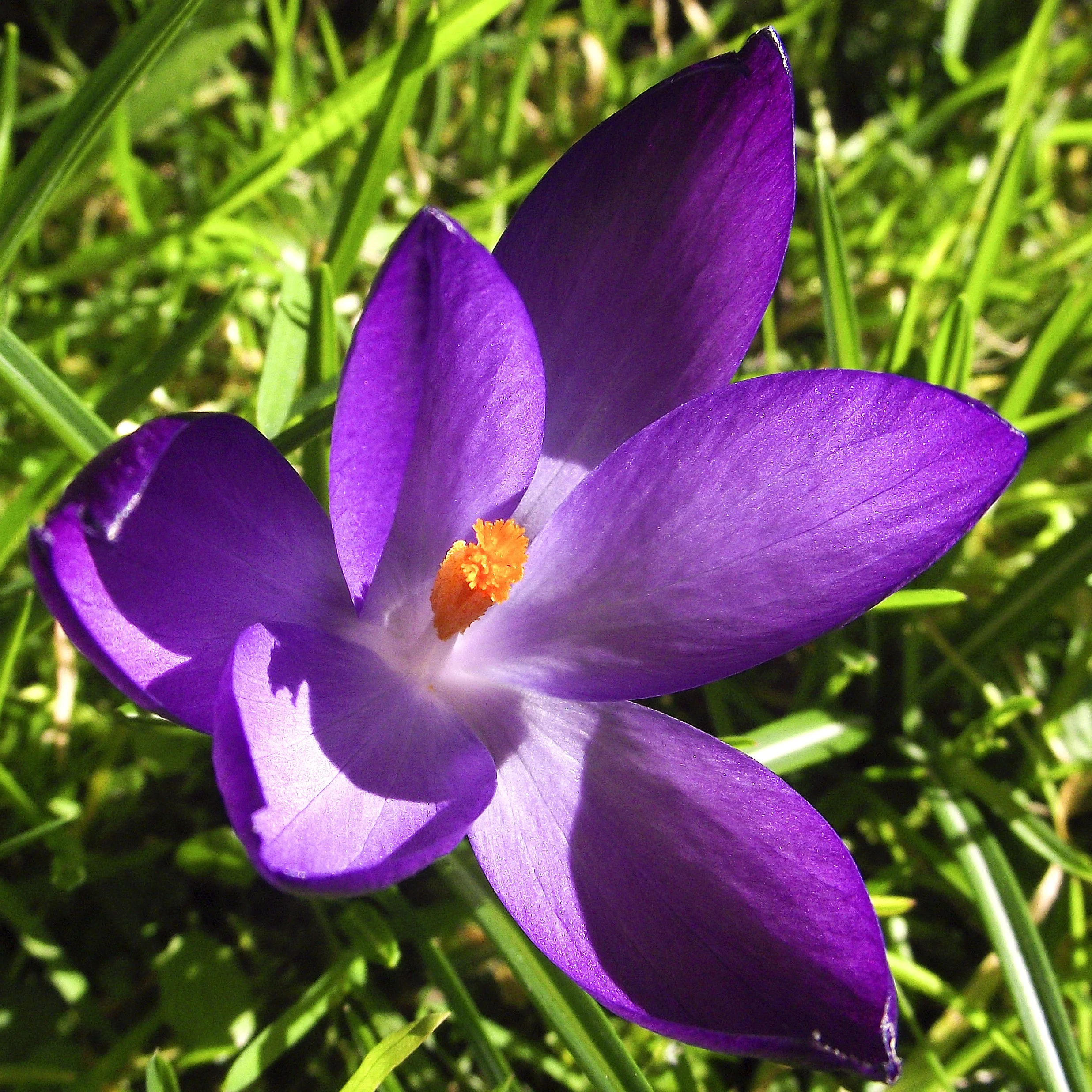
On Facebook, my New England friends post pictures of budding purple crocuses and brave blades of grass emerging after the deluge of snow.
Even in Florida, there are signs of spring (mostly because everyone complains about their allergies) but I smell the orange blossoms and see the palms flowering. The signs are more subtle here and disappear fast into the broiler -commonly known as summer- but before they do, spring is a wonderful time to re-awaken.
There is a rune that looks like a capital I, Isa. When I used to read my runes regularly, I’d always kind of gasp when I’d pull this one because Isa symbolizes “no movement” but to me, that meant stuck. Isa is more accurately described as standstill and metaphorically corresponds to the season of winter, a time of dormancy, of seeds waiting.
When I put my own self-process into the natural life cycle, I quickly understand the need for stasis before activity. This has enabled me to embrace the stillness, the emptiness, the waiting - the winter before spring.
But now this season of gestation is over, the seeds are awakening, ready to germinate and create new life, new beginnings, new opportunities.

Across the globe, signs of spring are here! For those who live where there are distinct seasons, it’s easy to see the world re-awaken with blooming flowers and trees, birds returning and people emerging from their houses.
On Facebook, my New England friends post pictures of budding purple crocuses and brave blades of grass emerging after the deluge of snow.
Even in Florida, there are signs of spring (mostly because everyone complains about their allergies) but I smell the orange blossoms and see the palms flowering.
The signs are more subtle here and disappear fast into the broiler, commonly known as summer.
But before they do, spring is a wonderful time to re-awaken.
There is a rune that looks like a capital I, Isa. When I used to read my runes regularly, I’d always kind of gasp when I’d pull this one because Isa symbolizes “no movement” which to me meant stuck.
Isa is more accurately described as standstill and metaphorically corresponds to the season of winter, a time of dormancy, of seeds waiting.
When I put my own self-process into the natural life cycle, I quickly understand the need for stasis before activity. This has enabled me to embrace the stillness, the emptiness, the waiting - the winter before spring.
But now this season of gestation is over, the seeds are awakening, ready to germinate and create new life, new beginnings, new opportunities.
What does this spring hold for you?
What projects have lain dormant and are now ready to have new life breathed into them?
Spring is a time of shifting so this season may require a re-orientation or perhaps even some re-prioritizing. I suppose that’s why we spring clean – to brush out the old and make way for the new.
For me, it’s simple. There are natural projects that yearn for my attention and it’s time for me to plant and get my hands dirty in the earth. It is also time to delve deeper into a few creative ventures I’m currently undertaking primarily focused on writing and course development.
So as you approach this spring season, what opportunities are lying in wait for you?
Is it time to make a move, start a new class, finish up a project that’s been lingering?
Ask for guidance from within and you’ll know what awaits you. Bring yourself back in alignment with nature and allow this awakening energy to stir your inner voice and creativity.
Be sure to tell us what exciting things spring has in store for you!
Leave a comment right underneath!
Let's make a list of what we plan to accomplish!
Join our ever expanding community. Sign up today! FREE
The Wisdom to Know the Difference
God grant me the serenity to accept the things I cannot change; the courage to change the things I can; and the wisdom to know the difference.
Not long ago, I was at a conference and heard a journalist share about her recent interview with Dr. Wayne Dyer. She’d asked him about the Serenity Prayer, wondering how we can develop the wisdom to know the difference.
Her query got me thinking. How do I know when to surrender and when to act? And then it hit me.
I can only change one thing, ME -- my words, my actions and my thoughts.
When I decide to take control, I’m in charge and responsible for my life. From this place I feel empowered because I can indeed effect change and evolve myself.
Accepting the things I cannot change is harder.
God grant me the serenity to accept the things I cannot change; the courage to change the things I can; and the wisdom to know the difference.
Not long ago, I was at a conference and heard a journalist share about her recent interview with Dr. Wayne Dyer. She’d asked him about the Serenity Prayer, wondering how we can develop the wisdom to know the difference.
Her query got me thinking. How do I know when to surrender and when to act? And then it hit me.
I can only change one thing, ME -- my words, my actions and my thoughts.
When I decide to take control, I’m in charge and responsible for my life. From this place I feel empowered because I can indeed effect change and evolve myself.
Accepting the things I cannot change is harder.
We all want other people to change. Being a recovering perfectionist, I was always attempting to improve family members and in particular, my spouse. It never worked and instead, created more tension, ill will and frustration for both of us.
But even more than wanting to control the people in my life, I felt compelled to heal the world, vacuum up all the smog and carbon in the air, single handedly clean the oceans and rivers. Every time I heard about a natural disaster somewhere my heart hurt and I felt responsible. I had to do something about it.
Then it dawned on me one day that I couldn’t.
I couldn’t magically make everything better (at least not yet). Focusing on all of the negativity oppressed me too, and made me feel helpless. That’s when I had to re-think what I can and cannot change.
I still care about our environment and about the people in my life but now instead of allowing myself to be overwhelmed, I ask what can I do?
I can love and accept my family.
I can recycle, buy local or sustainable products, donate my time or money, drive a hybrid, ride a bike or walk.
I can pray and envision the world I want for my children.
The wisdom lies in the knowing–that all I have control over is me.
At first it can sound limiting and limited. But in reality, when we change ourselves and how we show up in the world, we can change the world. So the next time you’re wondering how to know the difference, ask yourself, “Is this about me or about my need to control or save someone else?” And pretty quickly you’ll have an answer.
How have you interpreted the Serenity Prayer?
Let me know your thoughts.
Leave a comment below!
Receive my weekly emails and other goodies directly to your inbox. Sign up TODAY!

3 Reasons Why Rejection’s a Good Thing
It’s nearly that time of year when high school seniors start hearing from colleges – hoping to be accepted and dreading the rejection letters. I remember those days, the anxiety and nervous energy, waiting to see what the future held.
In the 30 years since I awaited my own set of letters, I’ve learned a lot about rejection. That contrary to popular belief, rejection may not be the enemy, but instead can often be a helpful guide.
I say this because we don’t always know what’s in our best interest. I might think that working for large corporation A is my dream job only to find when they don’t hire me, that small organization B was exactly where I fit and what I needed to both build my skills and open new doors. Rejection offers us a chance to re-think our plan, to realign or challenge our initial beliefs and ensure that where we think we want to go is indeed in our highest and best good.
Here’s How Rejection is Helpful
It’s nearly that time of year when high school seniors start hearing from colleges – hoping to be accepted and dreading the rejection letters. I remember those days, the anxiety and nervous energy, waiting to see what the future held.

In the 30 years since I awaited my own set of letters, I’ve learned a lot about rejection. That contrary to popular belief, rejection may not be the enemy, but instead can often be a helpful guide.
I say this because we don’t always know what’s in our best interest. I might think that working for large corporation A is my dream job only to find when they don’t hire me, that small organization B was exactly where I fit and what I needed to both build my skills and open new doors.
Rejection offers us a chance to re-think our plan -- to realign or challenge our initial beliefs -- and ensure that where we think we want to go is indeed in our highest and best good.
Here’s How Rejection is Helpful
1. We Get What We Need.
When I was a senior in high school, I really wanted to go to Brown University. It was my first choice not because I thought it was the best fit for me but because I wanted to please my parents. Then they could boast that I was at an Ivy League school. I’d also feel validated that I was indeed smart. I didn’t get in – along with 90+ percent of the other applicants. Instead, I went to Boston University.
Initially I felt rejected and lost. How could Brown not want me? I’m not good enough, smart enough… until one day I was listening to that famous Rolling Stones song and was reminded that I might not always get what I want but I get what I need.
I know it’s a cliché, but in that moment a light bulb went on and I realized that was precisely what had happened. I’d worked my tail off in high school and soon discovered that BU was easy for me after the rigor of a private New England prep school. The truth was that I got an amazing education in high school. I’d learned how to think, how to analyze and apply information. What I needed in college was to develop my social and emotional skills so I could both understand myself as well as interact comfortably and confidently with others. And that is exactly what I got.
2. 3s the Charm
About 10 year ago I went to a workshop focused on money and success with Harv Eker. It was one of those marathon weekends where participants work in large hotel conference rooms from early in the morning until nearly midnight.
One of my takeaways from that intensive was to be ready for rejection AND try again. We have to be willing to try at least 3 times to succeed. Most people hear “no” once and give up. Our challenge is to hear “no” and persevere right through that until we hear “yes.”
3. It Isn’t Personal
I recently submitted a book proposal for a competition that a publisher was holding. I didn’t win. At first I was a little shocked but then I told my daughter that they’d received something like 160 entries. She looked at me and said, “Mom, that’s less than a 1% chance!”
I suddenly realized she was absolutely right. And I also reminded myself that it wasn’t a personal rejection. Later, I was talking to an art friend of mine. She said, “I tell everyone – submit, submit submit. Because what a committee will choose today is different than what they’ll choose tomorrow. Don’t be afraid.”
Instantly I knew she was right too. Committees are made of people and they may like Sculpture 1 today and Sculpture 2 tomorrow just as they may like Book X today and Book Y tomorrow.
It’s about how we interpret these momentary set backs.
Do we allow them to shut us down and internalize them to think we’re bad, unworthy or undeserving? Or do we use rejection as fuel to carry on regardless knowing that we’re getting what we need in the moment and that life’s taking us exactly where we need to go.
Like lots of things, it’s a re-frame. When we can look at rejection not like an enemy but instead as a fact of life, a roadblock, or even a helpful guide, it can help us embrace it and learn from it rather than allow it to haunt us.
As I said to my 15 year-old this morning when I dropped her off at school, “Take chances! Challenge yourself.” That’s the way we truly grow by stretching ourselves and being willing to take risks. And built into that is rejection. So we might as well get used to it.
Been rejected?
Share how you managed it below!
Let's start a dialog. Leave a comment, I'd love to hear it.

Getting Beyond BUT
I don't know about you but there are some days when I don't feel like doing anything. I want to roll over and turn off my alarm clock, put the pillow back over my head and sleep. Then there are days when I actually do get up because I have to take my daughter to school and I have all the best intentions. I actually dress in my workout gear drive her to school only to come back home and, you can guess, climb back into bed. Don't get me wrong, I think it's great to have a day off, or even a mental health day, a day to do nothing or even a day to simply be unstructured. In this work obsessed culture, it's totally healthy and necessary. But what happens when the once in awhile turns into every day? Every day turns into week after week and suddenly your year is filled with - I don't want to...

I don't know about you but there are some days when I don't feel like doing anything. I want to roll over and turn off my alarm clock, put the pillow back over my head and sleep. Then there are days when I actually do get up because I have to take my daughter to school and I have all the best intentions. I actually dress in my workout gear drive her to school only to come back home and, you can guess, climb back into bed. Don't get me wrong, I think it's great to have a day off, or even a mental health day, a day to do nothing or even a day to simply be unstructured. In this work obsessed culture, it's totally healthy and necessary.
But how do we know when we should honor that voice telling us we need more rest, time off, etc and when we need to move past it and get on with our day, our year, our life? For most of us, it's by having eternal accountability which typically takes the form of boss. We know that if we're late to work again or absent another day, we'll get fired. If we miss too much school we could fail or get expelled. So these external factors motivate us to get up and go. And they work great at that, right? Most people roll out of bed, into the shower and are dressed and off to work even on the days they might not want to be going. Typically we are happy we have shown up in our lives too.
We can use this same concept of external accountability to help us with other things we want to accomplish but face similar resistance about. Things ranging from weight loss to running a marathon to completing any task or chore. Often we neglect to give ourselves the time to do the things we most want in our lives and find loads of reasons why we simply don't have time or have to clean all the windows in the house instead.
Is there something in your life that you've been hankering to do but haven't gotten around to yet? Maybe it's planting a vegetable garden, learning how to surf or making a photo album of your last trip. If we can create a way to include some kind of accountability, it will help us achieve that goal. Maybe a friend can help or we sign up for lessons or simply give ourselves a completion date. All of these can help to create motivation so we can get beyond BUT.

A Prisoner to Anger?
Recently I found myself irritated and annoyed by someone in my life. I was struggling with acceptance and found myself aggravated and put out. My mind was on a circular track, like a broken record stuck in a groove, repeating over and over again, allowing me to wallow in my negativity.
Recently I found myself irritated and annoyed by someone in my life. I was struggling with acceptance and found myself aggravated and put out. My mind was on a circular track, like a broken record stuck in a groove, repeating over and over again, allowing me to wallow in my negativity.

Later that day, I went to a discussion group. We read and talked about passages reminding me that I am not my mind. I am not even my thoughts! The conversation gave me objectivity and helped me break out of my negative pattern. I began to let it go. As I sat there contemplating my own process, I started to see how my anger and frustration were holding me prisoner in my mind. It had control over me because all I could think about and fixate on was feeling wronged. Then I thought, "do I really want to give this person that power over me?" Wow. Of course the answer was a resounding, "NO!"
Toward the end of the discussion, another member shared that he also was trapped in resentment. Those weren't his words, exactly. What he said was that he wasn't able to get passed a person who'd wronged him. It sounded like it had happened a long time ago.
Of course the first words that came to my mind were, "you have to forgive him, the person who wronged you." But the gentleman wasn't hearing this. I looked at him and could see that his anger had distorted his facial features. Listening, it became clear that he'd allowed the bitterness to even define him. Who was he if he wasn't betrayed?
This man was mirroring my own inner conflict. I saw in front of me how the anger we hold onto, really holds us. Just as I'd been locked in a prison cell all day with my obsessive thoughts, I could see this man was too. For him though, it had been years.
There is a quotation often attributed to the Buddha or Pema Chodrun but the origin is actually from Alcoholics Anonymous, "Anger is like drinking poison and expecting the other person to die."
What I felt inside myself on Monday and what I saw with this gentleman, was that quotation playing out exactly. We are the ones who feel the anger so ultimately it is punishing us. When we forgive, we set ouselves free. It's the irony of forgiveness. Our egos resist it so much, "we've been wronged! She's hurt us!" But the reality is that we are the ones who go on hurting ourselves over and over again by holding onto that pain. So I am resentful. How does she know? She has no idea. She doesn't feel my anger, only I do.
When we forgive, it doesn't mean that we forget or even deny that another person hurt us. It doesn't remove their responsibility, minimize or justify their actions. We can release the emotions without excusing the wrong. Forgiveness allows for an internal peace, helping us go on with life.
Sometimes when we've been holding anger for so long it can be hard to forgive. Louise Hay recommends that even if we're not ready to forgive we can be "willing to forgive." The Universe will support even our willingness and help us get there. Along with the mental health benefits of releasing resentment are the physical health benefits. As the Mayo Clinic reports, forgiveness allows for less anxiety and stress, lower blood pressure and reduced risk or alcohol or substance abuse.
So don't think about forgiveness as something we do for another person, think about it as a gift we give to ourselves. Be willing to walk over that proverbial bridge to the other side, the side of healing, love and empowerment. As Louise Hay says, "I forgive and I set MYSELF free."

A Life of The Mind? What About A Life of the Heart?
Growing up in New York City, I was surrounded by intellectuals and an analytical culture. Both my father and stepfather relished doing the Times crossword puzzles, looking forward to completing them daily (without Google). My father even undertook the Sunday diagram-less ones, sketching them out onto graph paper. He was stingy by nature but never scrimped when it came to learning. He'd pay for any course I wanted to take to "better myself." Meanwhile, my mother and stepfather spent every evening discussing politics and theatre. So naturally, as a teenager that's what I emulated. For "light reading" I chose novels like Sophie's Choice and The Sound and The Fury. In high school, I began reading about current events so I could sound knowledgeable but towards the end of my college years, I began to wonder about all of this critical analysis and the pursuit of a 'life of the mind.'
Growing up in New York City, I was surrounded by intellectuals and an analytical culture. Both my father and stepfather relished doing the Times crossword puzzles every day. My father even undertook the Sunday diagram-less ones, sketching them out onto graph paper. He was stingy by nature but never scrimped when it came to learning. He'd pay for any course I wanted to take to "better myself." Meanwhile, my mother and stepfather spent every evening discussing politics and theatre. Naturally, as a teenager that's what I emulated. For "light reading" I chose novels like Sophie's Choice and The Sound and The Fury. In high school, I following current events so I could sound knowledgeable but towards the end of my college years, I began to wonder about all of this critical analysis and the pursuit of a 'life of the mind.'
My first inclination that maybe this wasn't the exact path for me was when I took a class on Eastern philosophy and religion. One student presented an argument juxtaposing 'critical anlysis' or breaking things down in order to understand them, to a Buddhist concept of embracing the whole. I suppose that conversation planted a seed because after that I was never quite the same. Yeah, I could banter and hold my own dissecting a film or criticizing a political perspective but I'm no intellectual, not in the way many of my family members were, and I started to see that I was moving in a different direction anyway. After all, wasn't I more than just my mind?

As I let go of the obsessive need to follow the daily news and began my own inner journey, reading books and finding teachers, I kept encountering this idea, to live from the heart. I didn't know what that meant or how to do it- so I went searching. One of the things I learned was that the mind isn't in fact all there is. It's just a muscle that likes to think it's in charge. It'll boss you around forever if you let it. It can create countless fantasies, both good and bad, is a master at imparting fear and loves to judge BUT if you tame it, it can be an amazing machine.
When we choose to approach the world from the place of the heart, we allow ourselves to open up to the experience rather than the constant narration our head's telling us about what we 'should' be seeing or doing. We defer judgment or rationalization and allow ourselves a more holistic and accepting view. People often say the heart is the home of intuition, the place where your true self lives. I would argue it is also the place of knowing.
So to live from the heart isn't about not using the critical mind, being lazy or for people who are intellectually inferior. In fact, it is quite the opposite. Leading with your heart invites a person to tap into innate knowing as well as honing the mind to do the heart's bidding. Then we can live from a place of purpose and fulfillment instead of criticism and arrogance.
I know sometimes now when I go out to dinner with my family or intellectual friends in New York, they think I'm weird. Instead of tearing down the latest production of Macbeth, I prefer to talk about the talent. Or better yet, important subjects like the meaning of happiness or success. I'm sure that after some of these evenings my friends go home scratching their heads but at the end of the day, I feel peace and clarity, am not relying on Xanax or Ambien to alleviate my anxiety and sleep like a baby, contented.

You - The Only Relationship That Really Matters
About a month or so ago, she and I'd been on the phone when she'd started crying telling me about the inner work she'd begun, trying to understand herself better and address her "issues." In the journal entry/email she'd forwarded to me, I could see her honesty right there on the page. She was indeed delving into areas of discomfort like self esteem, body image and negative habits.
I woke up this morning, checked my email and found one from my 19 year-old daughter, Ayu, with the subject line PLEASE READ. Of course it was the first thing I did.

My gorgeous daughter, Ayu.
About a month or so ago, she and I'd been on the phone when she'd started crying telling me about the inner work she'd begun, trying to understand herself better and address her "issues." In the journal entry/email she'd forwarded to me, I could see her honesty right there on the page. She was indeed delving into areas of discomfort like self esteem, body image and negative habits. But what she said that really got my attention was:
People my age are obsessing about their relationships with other people: friends, lovers, family, professors, coworkers, etc. But the relationship I am most interested in right now, is my relationship with myself. Sure, we go through rough patches. Sometimes I’m a little more judgmental than I should be, and sometimes I get mad at myself. But hey, that’s normal. What’s important is that I’m in a committed relationship with myself, and I’m willing to do whatever it takes to make it work, because I’m worth it.
And I realized that she was absolutely right, our relationship with ourselves is the only one that really mattters.
Recently I was working with a woman who just retired. She'd been looking forward to this for quite a while but was being undermined daily by her high level of anxiety. In our talks, she realized that throughout her life, she'd allowed herself to be so "busy" she never had time to deal with herself. Suddenly, her all consuming job had dropped away and she was left face to face with herself.
Why is it that we spend so much time, like Ayu says, focused on our relationships with others or like the retired woman, on our jobs while avoiding our relationship with ourselves? Is it that we are afraid? What do we think we might find? If I look in the mirror of my soul, what will I see?
I first started doing this internal work in my early twenties, when I was trying to release myself from an eating disorder. It was through this inquiry that I began to see my eating was just a symptom of something deeper. As I delved into that, I learned that I ate to give myself love, to be nurtured and to quell my anxiety. But inner work, the real work of our lives- to understand and love ourselves- is on-going. I have heard it described like peeling away the layers of an onion, spiraling back around again and again.
We are all afraid of what we are going to see when we look into the mirror of our souls but the truth is, if we are wounded, what we see is a little girl (or boy) desperate to be loved. As we open our hearts with compassion and love to that "inner child" we allow ourselves to be healed. The old wounds fall away and our true beauty shines through. We release the pain and it sets us free.
It's easy to avoid ourselves and focus instead on a family member, job or numbing out with drugs, alcohol or too much TV. We're all inclined to run away from understanding who we truly are and what we are doing here. But if we can pause long enough to be with ourselves, we might discover that contrary to what we were taught or what was modeled for us, we are all profound, capable of loving and of being loved and can be our own best friends. This is truly the relationship that matters most and deserves our total commitment.

Piglet and the Art of Gratitude
When I was a little girl, I loved Winnie the Pooh. He was the character from the A.A. Milne books that I most identified with and consequently, had a small, stuffed doll in his likeness. His simplicity and unfailing kindness always cheered me. I cherished my Pooh bear and every summer when my sister and I went to sleepaway camp, I'd bring him with me.

When I was a little girl, I loved Winnie the Pooh. He was the character from the A.A. Milne books that I most identified with and consequently, had a small, stuffed doll in his likeness. His simplicity and unfailing kindness always cheered me. I cherished my Pooh bear and every summer when my sister and I went to sleepaway camp, I'd bring him with me. For years, my closest friend at Echo Camp for Girls was Darcy and she favored Piglet. So, you can imagine that we paraded around pretending to be and/or carrying our totems as we went on overnight trips or talked late into the nights.
In my twenties, I read The Tao of Pooh which brought me back to that wise and silly bear and gave me an even deeper understanding and appreciation for his timeless lessons. So I was surprised recently when I stumbled upon this A. A. Milne quotation, "Piglet noticed that even though he had a Very Small Heart, it could hold a rather large amount of Gratitude.” I never really thought all that much about Piglet but after reading that, I realized he could not be underestimated. After all, many of us may think we have small hearts. Piglet can serve as our inspiration in knowing that size is irrelevant when it comes to gratitude.
Seven days ago, I accepted my friend Gretchen's challenge to think of 5 things I am grateful for each day for a week with no repeats. Everyday I dutifully made my list, shared it on Facebook and Twitter, invited my friends to join. What was fascinating for me in this week was to realize just how much I am grateful for. The first "obvious" ones were the biggies that I think about a lot like my family, my health, and my career. But as I started to dig in, I noticed that everything from the shoes I wear to the face cream I apply I am grateful for. Then I also realized the gratitude I have for nature- for the sunsets, the rain, and the incredible array of animals in our world like Orca and Humpback whales, sea turtles, and Sandhill cranes.
In the mornings I experienced how, especially if I was tired or dragging, simply naming the 5 things I was grateful for changed my focus. Very quickly I'd be transported from feeling bad, thinking about lack or negativity, to an uplifting freer place. My breaths would deepen and I'd look around with smiling eyes, immediately reminded of all the good surrounding me in this moment.
Practicing gratitude is something found not just in children's books but in many spiritual practices. In an interview on UC Berkeley's Greater Good website, Brother David Steindl-Rast, a Benedictine monk, author and leader in the gratitude movement discusses its power, not only to the individual practicing it but to society and ultimately the world at large. He says, "...grateful individuals live in a way that leads to the kind of society human beings long for. In many parts of the world society is sick. Keywords of the diagnosis are: Exploitation, oppression, and violence. Grateful living is a remedy against all three of these symptoms. Exploitation springs from greed and a sense of scarcity. Grateful living makes us aware that there is enough for all. Thus, it leads to a sense of sufficiency and a joyful willingness to share with others. not only to the individual practicing gratitude but to society and ultimately the world at large..."*
Sometimes it's easy to read quotations from great thinkers like Brother David, Maya Angelou or Eckhart Tolle and feel intimidated, like they can do this because they are so much more advanced. This is when I remember Winnie the Pooh, the most simple of bears and his friend Piglet who is a rather timid little fellow, always afraid but wanting to be brave. If he can acknowledge that his heart is small but can hold a lot of gratitude, then so can you and so can I. It's easy to underestimate the capacity of the heart but it will grow. I promise.
With this, I invite you today to undertake Gretchen's gratitude challenge. Do it for 1 week, and see how you feel. Feel your heart and experience how it will grow and expand. Watch how your mouth turns to smile more readily and see how you feel lighter. Before you know it, you may even find yourself humming while you hunt for acorns.
I Am Here To Be Seen
In 2011, I signed up to attend a 5-day professional training called "Coaching Happiness" with Dr. Robert Holden. I arrived in New York City in November, a year after my father had died there. A year of grieving that had left me pretty vulnerable. It was time for some happiness in my life after so much sadness. I was excited about the workshop but nervous too. I had been reading Robert's book, Be Happy and knew right away that his message was for me.
In 2011, I signed up to attend a 5-day professional training called "Coaching Happiness" with Dr. Robert Holden. I arrived in New York City in November, a year after my father and younger sister had died. A year of grieving that had left me emotionally spent. It was time for some happiness in my life after so much sadness. I was excited about the workshop but nervous too. I had been reading Robert's book, Be Happy and knew right away that his message was for me. My husband had bugged me to sign up for the workshop. "It's gonna sell out." They were only taking 100 people. So instead of procrastinating like I usually do, I went onto Hay House and booked it.

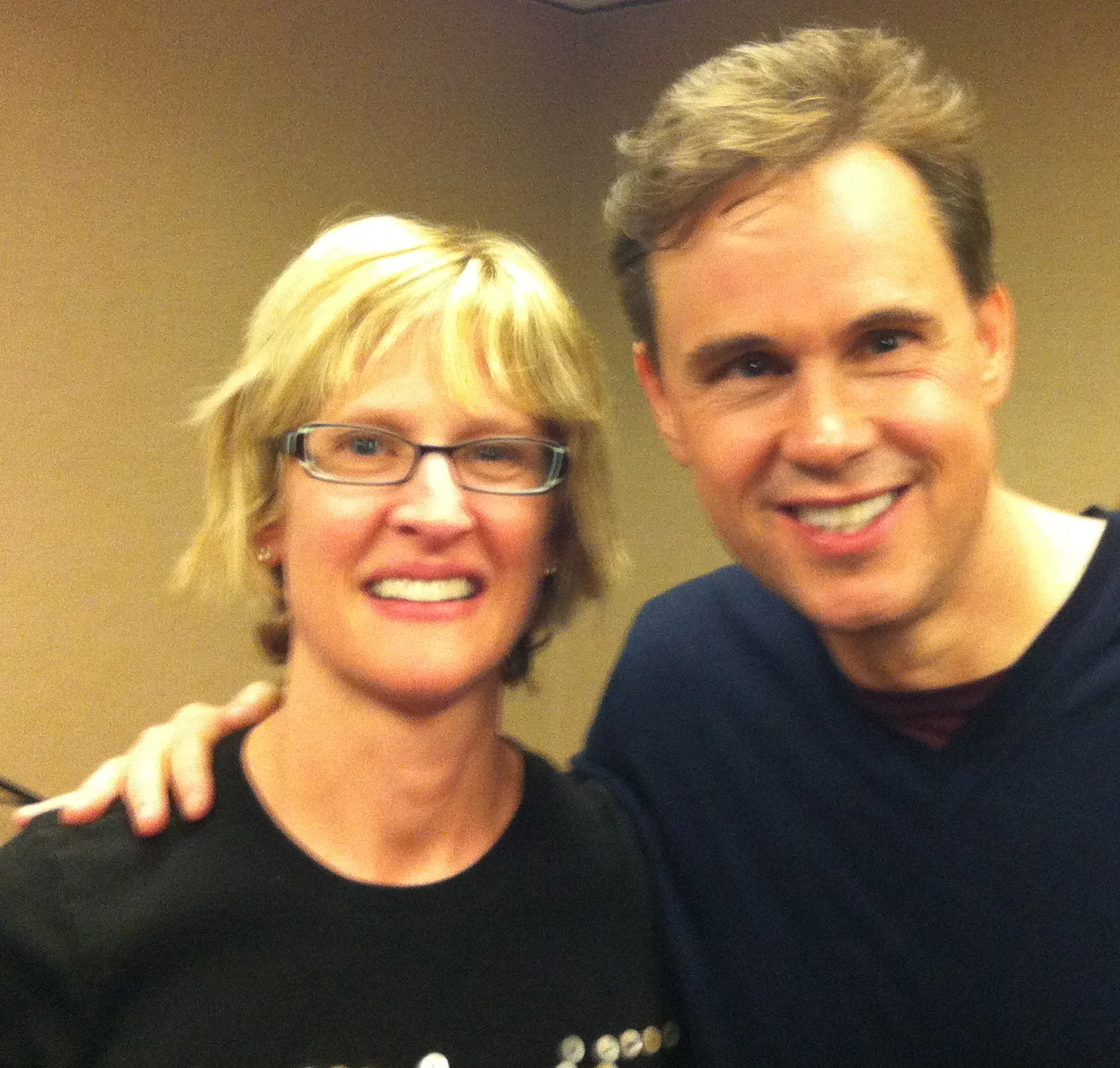
Robert Holden with me in November, 2011
The workshop was held in a hotel in Times Square, not exactly my normal hang out when in New York. But I was reminded of something my friend Jeff had said to me a year or two earlier. His office is in Times Square. When I asked him how he coped with all the annoying tourists he smiled. "I like it actually, it's invigorating. Sometimes I just come out and walk around, breathe it all in."
Okay, I thought, I will try to channel my inner enthusiast instead of donning my grouchy New Yorker face. Almost immediately, I made friends. The seminar had a relaxed and festive atmosphere and the audience, 90% women, were clearly excited to be there. One of the activities we did as a group, one we did every day was a greeting. It's of African (Bantu) origin and the concept is that we bring each other into existence by seeing one another. Two people participate by holding hands, facing each other, and looking into one another's eyes. One person starts by saying, "I am here to be seen." The person listening then responds, "I see you."
So we began. I was initially nervous and tended to allow my partner to go first, taking the lead. It was easy for me to see my partner and hold a space of patience and loving kindness but it was harder for me to utter the words, "I am here to be seen." Sometimes they felt like they got caught in my throat and my eyes all almost got watery. Nevertheless, I participated, repeating the exercise 5-6 times every morning with different partners.
By the fourth day, heading into the seminar, I was feeling tired and emotionally raw. Sitting on the bus watching the gray streets go by, my mind was already anticipating the upcoming seminar. "I don't want to do that exercise this morning," I heard my inner brat whining, "I don't want to be 'seen' today. I just want to be left alone."
Then my wise self, observing the mental commotion reflected, "isn't that interesting, what you said, you don't want to be seen." Well, that started a whole internal dialog and a realization of how I have spent a good part of my life hiding in the wings, afraid to go on stage and "be seen."

Gretchen Laporta, Valentina Savelyeva and Louisa Nedkov from November, 2011
At the workshop, I participated in the morning greeting (I am here to be seen) after which we were asked to make groups of 4 and share how we were feeling and what we were experiencing. I decided to out myself. So I told everyone in my group the story of my ride into the seminar. My self disclosure seemed to surprise some of the listeners (maybe because I had acted my part so well) but everyone was loving and supportive. It was a cathartic moment for me, to realize consciously that I have been hiding.
I decided it was time to come out. Not just to that group at the workshop but in my life.
This week Brene Brown tweeted, "So excited to finally launch The Daring Way™ - it's all about showing up, being seen, and living brave! And that got me thinking again about being seen. I'd been reading her book, Daring Greatly, in which she says "Courage starts with showing up and letting ourselves be seen."
In September I launched my own coaching and therapy business, Decide Differently. I watched how the fear arose as I transitioned from being an educator, which I had been for over two decades, to a new field, where I felt like a fledgling. The mind chatter of "who are you to tell people what to do" and "why would anyone listen to what you have to say?" haunted me but I did it anyway and am even outing myself more with this blog!
Because the truth is that I have a lot to say and to share, we all do. I agree with Brene. When we "out ourselves" when we allow ourselves to be seen, when we invite ourselves to show vulnerability, we are alive. We are pushing beyond the comfort, beyond the known, we are allowing people to see all of us, the parts we like and the parts we like not so much. And this, too, also comes back to the happiness course I did two years ago. As Robert says, "Happiness is when we dare show people our original face."
Even though sometimes I don’t want to be seen and I still want to hide, I am recognizing it more and more and working with myself lovingly, gently, and encouragingly, just exactly as I would a small child in one of my classrooms. "You can do this, there's nothing to be scared of. We are all here to support and love you." And what I realize is the power that being seen has. It gives us the gift of feeling alive and connected, experiencing the love and joy that are all around us and within us.
So thank you Robert and thank you to all of the brave men and women who shared that 5-day coaching happiness workshop with me. I am a different person because of all of you and I know you see me.

Living with Anxiety: 5 Ways to Cope

It isn't just them either. Perhaps I have a job but find an abnormal growth on my neck or a typhoon is bearing down on close relatives. How do we live with this level of chaos? It's hard not to let anxiety creep in, take over and steer life. Anxiety is caused by big events but also the little ones too. I have to get to work on time, my car won't start, I forgot my computer cord at home... sound familiar?
What do we do? Do we allow ourselves to get sucked into the vortex of chaos, stress out and be overwhelmed by anxiety? It's an option, for sure but the price is pretty high, especially on our bodies: increased heart problems, stroke, thyroid and adrenal troubles, challenges sleeping, alcohol/drug addiction, obesity. Truthfully, it's hard not to get affected. After all, life's often crazy and chaotic. It's easy to get sucked into it despite our best efforts.
I used to think, "when this is over (fill in the blank), everything will settle down and I can get on with my regularly scheduled life." That was my false belief for years. Until one day it suddenly dawned on me that what I was experiencing was life! Things are going along and then invariably, slam! Something happens - the water boiler explodes, a daughter gets stranded at the airport, the dog breaks his leg, Aunt Helen gets rushed to the hospital. Sound familiar? Of course because we all experience it every day; Life. Somehow the exciting events- the raise, the anniversary celebration, the new car, never seem to undermine us, only the unexpected ones. So how do we take the upswings, the excitements, as well as the downturns in stride? Here are some ideas to help make life's unexpected ups and downs more accepting:
- Perpective /Gratitude - Some people say perspective helps. Perhaps another way to think about this is being grateful for what we have in life. "I have a warm bed. I live in a safe community, I have a solid job. I have a supportive spouse. I have a reliable car. I am healthy." When we focus on what we have in our lives, what is good, we can attract more of that to us. We can also feel lucky as so many people struggle to feed their families, to have a roof overhead. So when unexpected things do happen, we feel more of a cushion. It seems small compared to all the good we are experiencing.
- Breathing - Sometimes when I get really nervous or anxious, I stop breathing. The first time I noticed this was when I was in a crew regatta in high school. My boat was sitting under a bridge on the Stotesbury River in Philadelphia. It was the final heat and our coxswain was trying to get us in position, always a challenge with 8 oars. I was so scared I simply ceased breathing, the worse thing to do while exercising! Suddenly I realized, "I'm not breathing!!!" I then had to consciously think about it, "inhale, exhale, inhale, exhale." before I knew it the gun went off and we were rowing our guts out toward the finish line. Breathing is a great way to help the body relax. Anxiety causes us to create adrenalin and puts us on hyper alert: fight or flight. But most of the time we are not about to be attacked by a lion. Maybe we are stuck in traffic or have a term paper to complete in 10 hours. Breathing can help the body relax and help us to step out of the freneticism caused by anxiety. It can clear the mind too to think more rationally so as not to just react to the current situation.
- Positive Thinking & Affirmations - Many people wake up feeling anxious or dread. Every Monday for the last month or so, that's been me. As if the week is daunting and I think, "Gulp, here I go, into unknown territory. So much to do..." How do I manage those feelings? I talk to myself as Lousie Hay would say, "in kind and loving ways." I use affirmations to help manage my mind talk. I have a great CD of hers entitled "101 Power Thoughts." It's a little intense because she literally powers through this massive list of affirmations. A few years ago when I had a long commute, I would listen to it in the morning and it made a huge difference for my day. One that really stuck with me from those drives was when she says, "my thoughts are my best friends." And my mind responded, "really, since when?" Then I realized, why not? Why should our thoughts be our worst critics? Can't they be our best friends instead? Now when I find myself feeling afraid, feeling dread, I try to channel my inner cheerleader and remind myself that "only good lies before me" that "everything I do brings me joy" and it really helps.
- Meditation - Of course I also meditate which is my biggest savior. I started meditating in 1997 when a teacher/friend of mine said. "you need to meditate every morning." To which I replied, "I don't have time." She looked at me and said, "Make time." I am grateful to Lily Diamond for that because it has changed my experience of living. Sometimes I describe what meditation does for me as creating space around me so that I don't take the craziness of the world so seriously. Most of the time that works but I am human and sometimes life just seems to push me over the edge and I fall right into the chaos. Many Spiritual teachers talk about not getting sucked into the chaos of the world - the politics, the environmental degradation, the pain and suffering, our own personal challenges. And I think sometimes this can be misunderstood and interpreted as that they don't care, not true. I care deeply about the world so much so that the poverty, clear cuts, and violence I read about have often left me in a heap of tears. I have been physically affected by global tragedies but this response isn't helpful to me or the world. To "live in the world but not of it" allows me to operate from a place of compassion without physically taking on the pain. This is why I love meditation.
- Exercise - Anxiety is felt in our minds and in our bodies. One of the best ways to manage it is to do physical exercise, particularly aerobic exercise. Not only does it help to clear the mind, it makes us feel physically better from the release of endorphins. Sometimes when I am really stressed, I go for a run and when I'm done, I feel like a different person!
We all get to experience this world and we get to decide how that is. Are we going to allow the chaos to unseat us and fill our bodies and minds with anxiety? Or are we going to utilize tools to help us manage our lives and ultimately feel more in control? Of course the choice is up to us.