

Self Love or Shame?
I’m a big fan of Brené Brown because she’s willing to research topics that no one wants to talk about, like shame. One of my favorite books of hers is Daring Greatly.
In it, Brown says that shame needs three things to grow: silence, secrecy and judgment.
We all have shame, those places inside where we feel bad about ourselves, unworthy, embarrassed, ashamed.

I’m a big fan of Brené Brown because she’s willing to research topics that no one wants to talk about, like shame. One of my favorite books of hers is Daring Greatly.
In it, Brown says that shame needs three things to grow: silence, secrecy and judgment.
We all have shame, those places inside where we feel bad about ourselves, unworthy, embarrassed, ashamed.
I used to have a lot of shame around my body. I learned from reading Daring Greatly that this – our bodies – is the #1 shame trigger for ALL women!
When I was a binge eater, I was embarrassed both by my body but also by my behavior.
There were many lonely evenings when I’d buy a pound of peanut M&Ms or a packet of Oreo cookies and inhale the entire bag in an hour. I was ashamed that I had no control, that I'd consumed so much food like a vacuum.
Years after I overcame my eating disorder, I met my spiritual teacher, Ma Jaya. She was a wonderful storyteller and I especially enjoyed the stories about her early life, living in Brooklyn, married to a tough Italian man.
Back then, Ma was also overweight and (like many women) was perpetually on a diet. One night, she was enjoying her dinner when her husband made a wise crack, “eat a little more.”
After that, she stopped eating in front of him.
Instead, she’d hide a loaf of Italian bread in the bathroom. When dinner was over, she’d bring the salad bowl with all the leftover oil and vinegar with her into the bathroom and soak the bread in it, scarfing down the entire loaf.
Listening to her, I could relate. She was me. I never wanted anyone to see me binge eat. I always did that alone.
But she was also NOT me.
Even though she wanted to be thinner, she always raved about how gorgeous she was back then – voluptuous, sexy. She had no shame. She simply loved herself skinny and fat.
What about you?
Is there a part of you that you disown? An aspect of who you are that makes you feel ashamed?
I know people who are embarrassed because of their sexual orientation, because they don’t feel smart or intelligent, because they can’t stay sober, because they have dyslexia, OCD or ADHD.
Instead of ignoring that part of you, or pushing it away, can you pour love and light into it?
We do this by accepting it, by loving it, embracing it and opening up about it. When we share how we feel flawed, broken, or imperfect with someone we really trust, it helps heal us.
Empathy destroys shame.
How would that feel?
When I read Brené Brown’s book, it set me free. Why? Because I realized that the places where I judge myself or feel shame are so often the same ones that we all do.
Once I saw that these “flaws” weren’t really specific to me, it seemed silly to hold on to them anymore.
After all, we are spirit beings having a human experience. And I’m resolved to make this the best one ever – and that means loving ALL of me!
What do you think? Are you in? Share one thing you're ready to release!
Want more? Get my blog & other goodies in your Inbox FREE every Wednesday!

Who’s Limiting You?
I was listening to a speaker recently explain why people don’t obtain results. And do you know what she said?
It’s about our beliefs.
Think about one of the New Year’s resolutions you made ten months ago. Maybe, like many of us, you had ‘lose weight’ on your list. Let’s say fifteen pounds.
Have you accomplished it?

I was listening to a speaker recently explain why people don’t obtain results. And do you know what she said?
It’s about our beliefs.
Think about one of the New Year’s resolutions you made ten months ago. Maybe, like many of us, you had ‘lose weight’ on your list. Let’s say fifteen pounds.
Have you accomplished it?
Here’s the thing – if you don’t see yourself as a thin person- then you aren’t going to lose the weight because your belief and goal are not in alignment.
How do we free ourselves so that we can actually obtain what we want?
In other words, how do we begin to see how we may be limiting our own success or progress?
To understand this, we have to be willing to deep dive and go within. We have to ask ourselves three questions that will help us get to the heart of what we believe and why we think we may not deserve to achieve our goal- to be thin, healthy or rich.
Ready to dive in?
1. How Are You Limiting Yourself?
We are the only ones thinking in our brains, so guess what? We tell ourselves every moment of every day if we’re happy or sad, feeling motivated or not, seeing ourselves as successful or as failures.
Let’s use the above example about losing weight. Can you imagine yourself as a thin, fit woman? When you look in the mirror, are you able to see yourself as a size 4/6/8?
When you do this, what happens? Is it impossible? Is there a voice that tells you, it isn’t really you?
Sometimes when we reach beyond what is familiar, what we’re used to, we have to take a leap of faith. Because we’re talking about changing our habits of thinking. We get used to our thoughts – good or bad because they’re familiar.
But if those thoughts are limiting you, it’s time to change them.
And when we first begin to do that, these new thoughts can feel ill-fitting, like wearing in a new pair of shoes.
It seems weird and at first may not feel like you but the more you affirm what you do really want and see it as already done, the more familiar and comfortable those messages will become until it is you.
So – claim what you want! Look in that mirror every day and see yourself thin, healthy and fit!
Remember, you are not your own limitations!
2. Did Your Family Give You Limiting Messages?
Maybe when you dive into uncovering the blocks preventing you from losing fifteen pounds, you hear your stepmother tell you that you’ll never be beautiful or maybe the voice is your father’s saying, “you’ve always been fat” confirming it as your identity.
Perhaps the messages you received told you that you were stupid, unaware or clumsy because you were hyperactive or learned in a different way.
We all received negative comments growing up, I know I did and I even believed many of them for years.
But at some point we have to recognize that these messages, even though we take them on, really aren’t about us.
I remember watching a movie as a teenager in which one of the characters told another she was a fat person in a skinny person’s body and a light bulb went on. I realized I was the opposite – a skinny person trapped in a fat body. That a-ha moment helped me break through messages from my family about my identity and helped me hold on to a new view of myself.
What messages have you been able to overcome?
Remember, you are not your family’s limitations.
3. How Have Society's Messages Limited You?
What are the messages we get from the media and Hollywood? How have they shaped your thinking or are limiting your dreams?
Women are constantly inundated with messages about beauty and body. According to shame researcher, Brené Brown, the number one shame trigger for women is our bodies. We are never thin enough, fit enough, pretty enough… If we buy into these messages, we can make ourselves crazy.
When do we decide that we are enough?
When we stop defining ourselves by other people’s standards.
What about society telling us how to be successful?
I know a woman who dropped out of high school at 15. Just before she turned 50, she started a new business venture and now runs a multi-million dollar company!
If she’d listened to the messages from society, that she couldn’t be successful without a college degree, without even a high school degree, she might still be a waitress.
Instead, she recognized what she was good at, passionate about and kept following it. She hustled, worked hard and is now reaping the rewards.
You are not society’s limitations
Sometimes I think about Olympic athletes, how they often go above and beyond what we think is humanly possible. They break records, they inspire us with their abilities and sheer will to succeed. They go beyond all limitations – society’s, family’s, coaches, and even their own- to achieve greatness.
We all have that ability to go beyond those limitations and achieve our own greatness.
Are you ready?
Tell me what YOU are going to do by leaving me a comment BELOW!

The Ugly Twins – Guilt & Shame
Probably two of the most painful culprits in the emotional arsenal are guilt and shame. These two can seriously wreak havoc on us. It wasn’t until I read Brené Brown's work that I fully understand the difference between them AND how to let go of one and positively utilize the other.
Guilt is the feeling we have when we know we’ve done something wrong or hurt another. We feel bad about our actions. Perhaps I yelled at my daughter in an unkind way or I forgot to leave a tip for the waiter. My action results in me feeling guilty.

Probably two of the most painful culprits in the emotional arsenal are guilt and shame. These two can seriously wreak havoc on us. It wasn’t until I read Brené Brown's work that I fully understand the difference between them AND how to let go of one and positively utilize the other.
Guilt is the feeling we have when we know we’ve done something wrong or hurt another. We feel bad about our actions. Perhaps I yelled at my daughter in an unkind way or I forgot to leave a tip for the waiter. My action results in me feeling guilty.
Guilt can act as a reminder for right or wrong.
It’s like an internal morality indicator, letting you know if something you’ve done goes against your value system. Brené Brown writes, “[Guilt] is an uncomfortable feeling, but one that’s helpful. The psychological discomfort, something similar to cognitive dissonance, is what motivates meaningful change.”
Overall, when we experience guilt, it can propel us to make amends and change our behavior and so is seen as a potentially positive force.
Obviously taken to the extreme, guilt can be harmful and is especially destructive if we attempt to “guilt” another person, as in making someone feel bad if they don’t do what I want them to do.
Shame, on the other hand, is the internalization of wrongdoing with the interpretation not that my actions were wrong (that’s guilt) but that I’m a bad person because I’ve done this – (yelling, stiffing the waiter.) Then the berating, negative self-talk ensues. “How could I have done that? I’m so stupid, bad, a terrible mother…”
According to Brown, “…shame corrodes the very part of us that believes we can change and do better…” Shame harms us in that moment and her research indicates that, “shame is highly correlated with addiction, violence, aggression, depression, eating disorders and bullying.”
Shame is the voice of “I’m not good enough. I’m not lovable.”
It is who we become when we feel not enough. It is the choices we make to escape, check out, hurt ourselves or hurt others.
Because we’ve all been shamed in our lives and believed it, we now walk around feeling less than, feeling flawed, feeling like we are works in progress instead of wholly loved, talented, incredible beings.
As Brown notes, “Shame is so painful for children because it is inextricably linked to the fear of being unlovable. For young children who are still dependent on their parents for survival- for food, shelter and safety- feeling unlovable is a threat to survival. It’s trauma. I’m convinced that the reason most of us revert back to feeling childlike and small when we’re in shame is because our brain stores our early shame experiences as trauma, and when it’s triggered we return to that place.”
Now that we know more about shame and guilt, we can choose to listen to those old stories about who we are or make new ones. In the 25 years I’ve been working on myself, I see more and more clearly how simple it actually is. In fact, it comes down to one concept – are you ready?
Self-acceptance.
That’s it!
All the words of criticism I heard growing up made me think I wasn’t enough and hell, I wasn’t ever going to be enough. But really, whose words were those? Those were the words my father said to himself, my mother said to herself, my stepfather said to himself, and on and on and on. It really was never about me, I just mistakenly thought it was.
Now I know it isn’t.
As one of my favorite teachers, Dr. Robert Holden says, “no amount of self-improvement can make up for a lack of self acceptance.”
So there it is – self acceptance is the shame-buster.
It starts right here, right now by saying to myself, “Shakti, I totally love and accept you. Right now, just as you are. Just as I am.”
Okay, now it’s your turn. Let me know how it goes.
How have you experienced guilt and shame? Share with me by leaving a comment below!
And join our community- get our emails - FREE Sign up today!

It's All About Trust
A few months ago, right around the New Year, I wrote about Robert Holden's idea of choosing one word to be your guide for the year. A word that you could contemplate, evaluate and ideally embrace this year, 2014.
My word is trust.
Four months into my exploration with this word, I have come to see its many manifestations in my life.
For one, I will confess to not being terribly trusting - of myself, of others, of the future. All of this lack of trust is from my past, from not feeling supported or nurtured, and from thinking the world is an unsafe place. I have worked on this for a decade but am determined to shed my lack of trust this year. And this resolution has gotten me thinking about all the ways it manifests in my life.

A few months ago, right around the New Year, I wrote about Robert Holden's idea of choosing one word to be your guide for the year. A word that you could contemplate, evaluate and ideally embrace this year, 2014.
My word is trust.
Four months into my exploration with this word, I have come to see its many manifestations in my life.
For one, I will confess to not being terribly trusting - of myself, of others, of the future. All of this lack of trust is from my past, from not feeling supported or nurtured, and from thinking the world is an unsafe place. I have worked on this for a decade but am determined to shed my lack of trust this year. And this resolution has gotten me thinking about all the ways it manifests in my life.
Whether we want to believe it or not, trust defines our lives. It is how we view everything and our place in it.
Do I trust myself and my inner knowing?
What about the future?
Is the Universe benevolent and supportive?
Can I open up and trust my partner?
As I do this exploration, I am reminded of how trust transformed my love life.
When I was in my mid 30s, my marriage fell apart. I was as much to blame as my husband. I was naive and hadn't spent enough time nurturing our connection together. Instead, I allowed life to constantly get in the way and focused too much of my attention on my career and my children.
After that, I decided I was done with relationships and would devote my life to God (and my kids). I wasn't going to pursue another love partner. But, as the Universe typically works, we find love when we least expect it. This time, though, he and I were determined to do things differently, and as part of that made a commitment of total honesty and truth to one another. It was the first time in my life that I allowed myself to open up to someone and show them ALL of me - the parts I liked and was proud of, and the parts I disliked and was ashamed of. And here's what happened, I didn't get rejected. In fact one night he told me, "when you share like that with me, it makes me love you even more."
What!?!?!?
Yup.
As he and I walked through this new love I started to see that as I opened up and trusted him, I trusted myself more, I trusted God more. It was like this relationship was the gateway to trust and all the lines ran parallel. I opened to him, and everything else expanded.
In sharing this story, I am describing what Brene Brown writes in Daring Greatly about our willingness to be vulnerable. That's why we're afraid of trust - because it means we have to be vulnerable and we might get hurt. We are exposing ourselves. But, as she writes, "we need to feel trust to be vulnerable and we need to be vulnerable in order to trust."
Relationships are a great place to start. So try it. Choose one thing to share with your partner. One fear or desire. Maybe it's something you never told anyone before. How will you say it? Is there a good time? You'll know.
And then, tell us what happened! Leave a comment about your story or let me know what you thought of mine!
And if you liked what you read, sign up to receive more! I'd love to add you to our community.
I Am Here To Be Seen
In 2011, I signed up to attend a 5-day professional training called "Coaching Happiness" with Dr. Robert Holden. I arrived in New York City in November, a year after my father had died there. A year of grieving that had left me pretty vulnerable. It was time for some happiness in my life after so much sadness. I was excited about the workshop but nervous too. I had been reading Robert's book, Be Happy and knew right away that his message was for me.
In 2011, I signed up to attend a 5-day professional training called "Coaching Happiness" with Dr. Robert Holden. I arrived in New York City in November, a year after my father and younger sister had died. A year of grieving that had left me emotionally spent. It was time for some happiness in my life after so much sadness. I was excited about the workshop but nervous too. I had been reading Robert's book, Be Happy and knew right away that his message was for me. My husband had bugged me to sign up for the workshop. "It's gonna sell out." They were only taking 100 people. So instead of procrastinating like I usually do, I went onto Hay House and booked it.

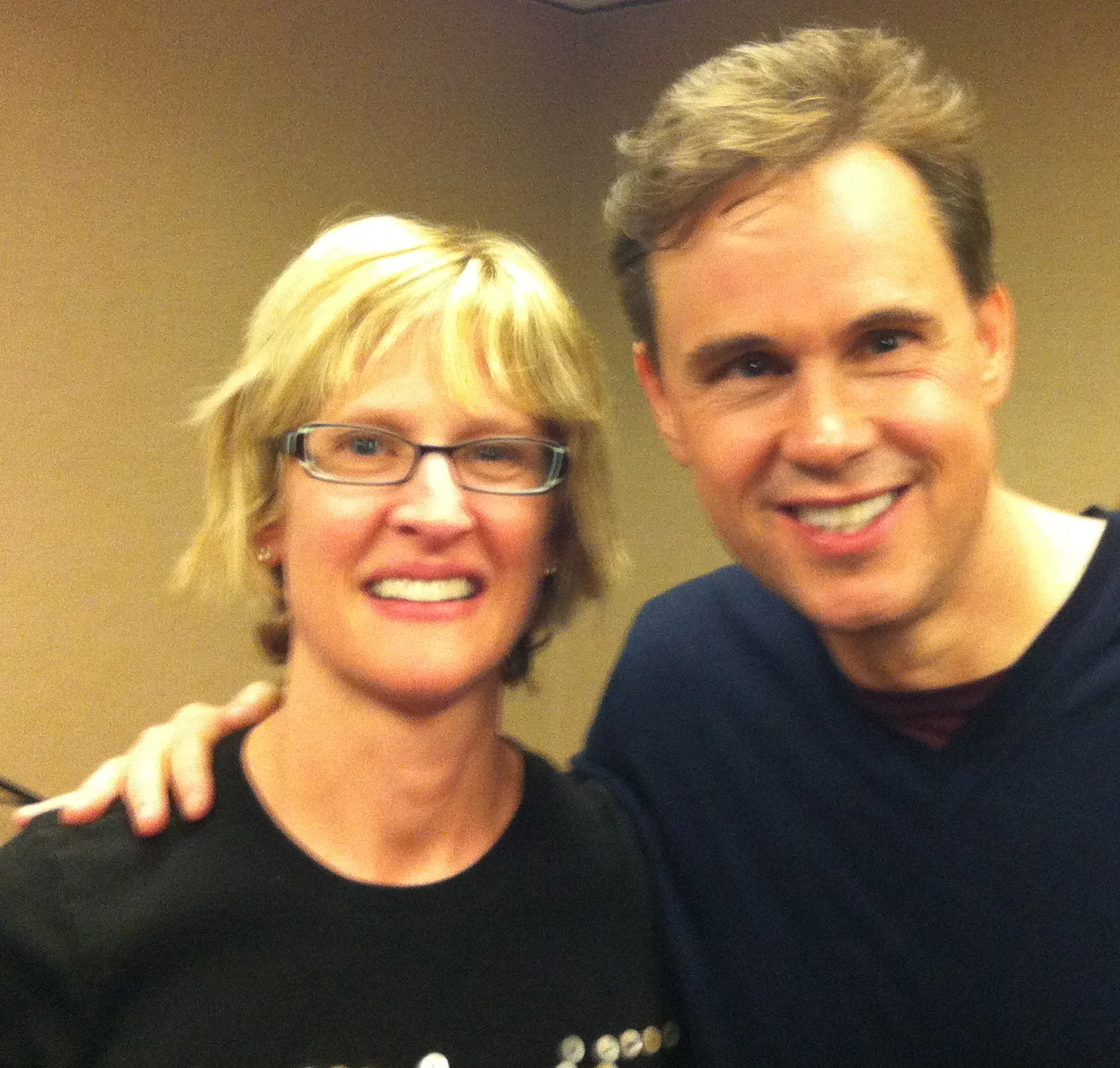
Robert Holden with me in November, 2011
The workshop was held in a hotel in Times Square, not exactly my normal hang out when in New York. But I was reminded of something my friend Jeff had said to me a year or two earlier. His office is in Times Square. When I asked him how he coped with all the annoying tourists he smiled. "I like it actually, it's invigorating. Sometimes I just come out and walk around, breathe it all in."
Okay, I thought, I will try to channel my inner enthusiast instead of donning my grouchy New Yorker face. Almost immediately, I made friends. The seminar had a relaxed and festive atmosphere and the audience, 90% women, were clearly excited to be there. One of the activities we did as a group, one we did every day was a greeting. It's of African (Bantu) origin and the concept is that we bring each other into existence by seeing one another. Two people participate by holding hands, facing each other, and looking into one another's eyes. One person starts by saying, "I am here to be seen." The person listening then responds, "I see you."
So we began. I was initially nervous and tended to allow my partner to go first, taking the lead. It was easy for me to see my partner and hold a space of patience and loving kindness but it was harder for me to utter the words, "I am here to be seen." Sometimes they felt like they got caught in my throat and my eyes all almost got watery. Nevertheless, I participated, repeating the exercise 5-6 times every morning with different partners.
By the fourth day, heading into the seminar, I was feeling tired and emotionally raw. Sitting on the bus watching the gray streets go by, my mind was already anticipating the upcoming seminar. "I don't want to do that exercise this morning," I heard my inner brat whining, "I don't want to be 'seen' today. I just want to be left alone."
Then my wise self, observing the mental commotion reflected, "isn't that interesting, what you said, you don't want to be seen." Well, that started a whole internal dialog and a realization of how I have spent a good part of my life hiding in the wings, afraid to go on stage and "be seen."

Gretchen Laporta, Valentina Savelyeva and Louisa Nedkov from November, 2011
At the workshop, I participated in the morning greeting (I am here to be seen) after which we were asked to make groups of 4 and share how we were feeling and what we were experiencing. I decided to out myself. So I told everyone in my group the story of my ride into the seminar. My self disclosure seemed to surprise some of the listeners (maybe because I had acted my part so well) but everyone was loving and supportive. It was a cathartic moment for me, to realize consciously that I have been hiding.
I decided it was time to come out. Not just to that group at the workshop but in my life.
This week Brene Brown tweeted, "So excited to finally launch The Daring Way™ - it's all about showing up, being seen, and living brave! And that got me thinking again about being seen. I'd been reading her book, Daring Greatly, in which she says "Courage starts with showing up and letting ourselves be seen."
In September I launched my own coaching and therapy business, Decide Differently. I watched how the fear arose as I transitioned from being an educator, which I had been for over two decades, to a new field, where I felt like a fledgling. The mind chatter of "who are you to tell people what to do" and "why would anyone listen to what you have to say?" haunted me but I did it anyway and am even outing myself more with this blog!
Because the truth is that I have a lot to say and to share, we all do. I agree with Brene. When we "out ourselves" when we allow ourselves to be seen, when we invite ourselves to show vulnerability, we are alive. We are pushing beyond the comfort, beyond the known, we are allowing people to see all of us, the parts we like and the parts we like not so much. And this, too, also comes back to the happiness course I did two years ago. As Robert says, "Happiness is when we dare show people our original face."
Even though sometimes I don’t want to be seen and I still want to hide, I am recognizing it more and more and working with myself lovingly, gently, and encouragingly, just exactly as I would a small child in one of my classrooms. "You can do this, there's nothing to be scared of. We are all here to support and love you." And what I realize is the power that being seen has. It gives us the gift of feeling alive and connected, experiencing the love and joy that are all around us and within us.
So thank you Robert and thank you to all of the brave men and women who shared that 5-day coaching happiness workshop with me. I am a different person because of all of you and I know you see me.