
You Said NOTHING?
Sometimes life can feel like an endless To Do List. This weekend, while I contemplated relaxing, got eaten up instead with household chores, entertaining and childcare.
Suddenly it's Monday again! The have-tos start as soon as the alarm goes off and the week can easily be absorbed with task fulfillment and checked boxes.
When this happens, my life begins to feel like a treadmill.
I walk, run, sprint but am on this endless go round. That’s when a little thought enters my mind and suggests it might be time to stop and do... nothing.

Sometimes life can feel like an endless To Do List. This weekend, while I contemplated relaxing, got eaten up instead with household chores, entertaining and childcare.
Suddenly it's Monday again! The have-tos start as soon as the alarm goes off and the week can easily be absorbed with task fulfillment and checked boxes.
When this happens, my life begins to feel like a treadmill.
I walk, run, sprint but am on this endless go round. That’s when a little thought enters my mind and suggests it might be time to stop and do... nothing.
That's right, I said it, do nothing.
This is like the antithesis of the American way now. In fact, think about how we meet and greet people. More and more often we say, "Hey, how ya doin'?" or "What did you do over the weekend?" We're conditioning ourselves to be rewarded by accomplishments, achievements, lists completed.
Isn't it a little embarrassing to walk into work after a long weekend and in response to "What did you do?" your answer might be "nothing." Do we not want to admit that? If we do we might be perceived as lazy, a slacker or even an avoider.
And it isn’t just weekends, Americans take less time off than any other workers in developed nations.
Not only do we have less vacation days than other countries -on average Americans get 10 paid days per year and 6 paid holidays versus a minimum of 20 in the EU. Studies also indicate that 51% of American workers don't even use all of their vacation time. What's more 61% actually work while they're on vacation. So even when we do finally take a few days off, it’s pretty common to be on the phone or checking email. Like we just can’t turn off or unplug.
For the past year, I've consciously made an effort at being less of a Do-er. Trying to slow down and check out.
To transition myself, I’ve been actively working on two concepts:
The first one is busyness.
Somehow because Americans have become these formidable Do-ers, we derive our self worth from that: doing- accomplishing, achieving, crossing all the items off the to-do list. When I’m trapped in that cycle I never have enough time. There's always too much to do. I run from task to task feeling rushed and anxious, knowing I'll never get it all done.
My first step was getting off the busy ride.
I decided it was okay not to get everything done. I was going to survive if I sent that email tomorrow, went to the post office on Friday or delayed a meeting until next week. The sky didn't fall, the business didn't close, and no one seemed put out.
Slowing down and being more realistic with my "have tos" has made my life feel increasingly peaceful and less stressful. In fact, I’m even learning how to say no! As in, it's ok not to do everything!
The second lesson as I keep moving away from busy is toward relaxing.
At first I implemented this just with my schedule. I started limiting the hours that I worked in a day adding more down time, exercise time, and trying to find a balance that felt good to me. I no longer wanted to feel like my life was so heavily lopsided by work.
It's been about a year since I've implemented this and overall, I accomplish as much if not more than I did rushing and feeling stressed. But I don't feel nearly as much anxiety, worry or tension.
Now the next phase is relaxing even more into the flow.
What I mean exactly is that I tend by nature to be impatient. I want everything done yesterday. Because of this, I can push, push, push instead of allowing something to unfold.
As part of my year exploring trust, I’ve come to understand that relaxing into life is really an exercise in trust. If I trust that my outcome is assured, or that only good will come to me then I can relax and not worry. I don't have to constantly shore up, fixate or feel the need to do, do, do. I can relax into knowing.
Last week I read a line in A Course in Miracles that says, "who would attempt to fly with the tiny wings of a sparrow when the mighty power of an eagle has been given him?"
And to me, that's relaxing into trust.
Why should I constantly try to flap with these mini wings, pushing with all my might when the Universe (or God or whatever word you like) can do it for me?
This feels so much better. It doesn't mean I lie on the couch ALL day, reading and watching movies. But it does mean that I smile more, am clear about how to cherish everyday and enjoy the ride that is this amazing journey of life, knowing that it’s all happening in the perfect time.
How do you experience your life?
Do you make time to relax?
Tell me what works for you by leaving a comment below.
Liked what you read?
Join our community, it’s FREE!

Happiness Is...
After spending the first 8 months of 2011 grieving and trying to get my life back together after losing both my sister and father in 3 months, I realized it was time for me to focus on me. Having been a pleaser and caretaker most of my life, this task felt daunting and I didn’t even know where to begin.
But as most things go, the Universe helped me out. A friend lent me a book about happiness by Dr. Robert Holden and immediately I knew I wanted to learn not only more about his ideas BUT also how to facilitate this work. Next thing, I was signing up to attend his happiness coaching certification in New York. I was ready finally to learn precisely how to be happy.
Turns out that there are different kinds of happiness (who knew?)

After spending the first 8 months of 2011 grieving and trying to get my life back together after losing both my sister and father in 3 months, I realized it was time for me to focus on me. Having been a pleaser and caretaker most of my life, this task felt daunting and I didn’t even know where to begin.
But as most things go, the Universe helped me out. A friend lent me a book about happiness by Dr. Robert Holden and immediately I knew I wanted to learn not only more about his ideas BUT also how to facilitate this work. Next thing, I was signing up to attend his happiness coaching certification in New York. I was finally ready to learn precisely how to be happy.
There are different kinds of happiness (who knew?)
Robert defined happiness as pleasure, satisfaction and joy.
What’s pleasure?
Pleasure is a great piece of chocolate, a superb glass of wine. It’s what we enjoy through our senses, our bodies. And it feels good!
However, pleasure relies on a stimulus. I need to drink my coffee in order to feel pleasure and then when my coffee's gone, so is that pleasurable experience. It’s also exclusive to me. For example, I like dark chocolate but my daughter likes milk chocolate. Pleasure exists in duality too meaning that it has an opposite… pain.
We’ve all experienced pleasure, right? And pain…
The second kind of happiness we experience is satisfaction.
Satisfaction is the type of happiness most researched. So for you what’s satisfaction? Is it a job well done? A task completed? That feeling after you’ve finished a work out?
Satisfaction again is a result of something else. It’s causal like pleasure. "I am happy because…I ran 2 miles, got an A on that paper, have great friends…”
The cool thing about satisfaction is that it feels good AND it increases our ability to access gratification helping us be receptive to more satisfaction. We also experience it emotionally and mentally.
Satisfaction has a few problems though. Again, it’s short lived and exists in duality with its opposite being dissatisfaction. It can also be influenced by expectation and comparison and is largely based on our emotions.
The third definition or kind of happiness is joy.
What does joy mean to you? I like to think of joy as happy for no reason. It shares some attributes with pleasure since we feel joy physically. We can also experience it mentally and emotionally like satisfaction. But it’s more than any of those things in fact joy is simply bigger that our bodies, our egos, our personalities.
It’s pretty hard to define joy but we sure can describe it!
It’s happiness that bubbles out of us effortlessly. It’s the smile you can’t take off. And joy has specific qualities to it.
The first one is constancy.
Joy never goes away. WE wander away from joy when our attention and awareness strays but joy is always there for us to access.
Joy is the source of creativity.
It's the fountain. For those of us who grew up with the idea of the tortured artist, this is a big reversal. Turns out that joy feeds our creativity way more, hmmmm.
Joy is unreasonable.
That’s the “I’m happy for no reason.” Simply because. I'm choosing to tune into joy because it feels so good.
Joy has no opposite nor is it subject to mood swings or the craziness of the world.
Joy has a twin, which is love.
There are people who describe experiencing true joy or love in the midst of terrible suffering. People like Victor Frankl, an Austrian neurologist and psychiatrist imprisoned in concentration camps during WWII and a holocaust survivor. He writes in Man's Search for Meaning:
“For the first time in my life I saw the truth as it is set into song by so many poets, proclaimed as the final wisdom by so many thinkers. The truth - that Love is the ultimate and highest goal to which man can aspire. Then I grasped the meaning of the greatest secret that human poetry and human thought and belief have to impart: The salvation of man is through love and in love.”
Joy is enough.
We can experience a fall out from pleasure or satisfaction because they are temporary. But this never happens with joy. It's constant and completely fulfilling.
Turns out that true happiness is JOY.
The good news is, we can still appreciate and embrace pleasure and satisfaction, and joy. We can have it all!
But if we don’t work on connecting to joy, no matter how much pleasure or satisfaction we have, we’ll never feel happy. And if we fixate on pleasure or satisfaction, it can turn on us- making us into workaholics, addicts or create other excessive behaviors. Why? Because both pleasure and satisfaction are temporary.
If we tune into JOY it will enable us to have even more healthy pleasure and worldly satisfaction.
Here’s a quick video to re-enforce these concepts.
What do you think of these 3 definitions?
Leave a comment with your thoughts below.
And if you haven't yet, join our community today!
Don’t Let Time Pass You By
As most of you know, I’m teaching a happiness workshop this fall. In fact, it started last night and we'll be meeting together, exploring what happiness means to us for the next 8 weeks. I am thrilled to be on this adventure!
For the past couple of months leading up to last night I spent a lot of time reading and researching to see what the “experts” can tell us about happiness. One of the books I came upon is called, The Happiness Project written by Gretchen Rubin. In it she describes how she spent a year doing a research project in her life, planning various activities and behavior shifts each month to increase her level of happiness.
As most of you know, I’m teaching a happiness workshop this fall. In fact, it started last night and we will be meeting together, exploring what happiness means to us for the next 8 weeks. I am thrilled to be on this adventure!
For the past couple of months leading up to last night I spent a lot of time reading and researching to see what the “experts” can tell us about happiness. One of the books I came upon is called, The Happiness Project written by Gretchen Rubin. In it she describes how she spent a year doing a research project in her life, planning various activities and behavior shifts each month to increase her level of happiness.
One of the truisms she discovered during this year of exploration is “the days are long but the years are short.”
I really resonated with that.
Sometimes a day can feel interminable, never ending especially when I’m stuck doing things I don’t particularly love like housework. But when I look back to even this past year, now that it’s September, I think, “holy smokes, where has the year gone?”
After reading that line, I’ve decided to really make an even greater effort to enjoy my days, relish them, fill them (as much as I can) with all the things that make life worth living.
Things like:
Appreciating the sunny day
Noticing the flowers blooming next to my car
Bending down and taking a few moments to pet my dog
Relishing time spent with loved ones
Carving out an hour to be creative – in whatever way that is- dancing, collage, beading, cooking
Calling an old friend
Because I don’t want my year to end only to feel like I haven’t fully lived it with passion, determination, fun and caring.
The days are long but the years are short.
So even if the day seems long, what can you do to bring some sunshine into it?
Can you take a 5 minute break and listen to an uplifting song? Can you smile at a stranger for no reason? How about waving at the mail carrier or picking up a chocolate or some flowers for your honey?
Let me know if you have a good idea to brighten up your day.
Leave a comment below.
And join our growing community, sign up today.
You Want Me?
A few weeks ago I watched Annie Hall, the Woody Allen movie starring Diane Keaton and Woody Allen. I hadn't seen it in over 30 years and probably laughed harder and appreciated it more this time around.
The movie essentially is a study in Alvy Singer's (played by Woody Allen) rejection of the women in his life because he can't possibly fathom why they would want to be with him let alone love him.
He even likens it to the old Groucho Marx joke, " I don't care to belong to any club that will have me as a member."
In the film, we watch as Alvy systematically sabotages his relationships only to then regret it after they're over.
But then something weird happened. I actually started to see this same pattern playing out with people I knew in my everyday life. Twice I witnessed one partner goading the other, speaking harshly almost like the desire was to reject, push away, or create cause for a break up.
A few weeks ago I watched Annie Hall, the Woody Allen movie starring Diane Keaton and Woody Allen. I hadn't seen it in over 30 years and probably laughed harder and appreciated it more this time around.
The movie essentially is a study in Alvy Singer's (played by Woody Allen) rejection of the women in his life because he can't possibly fathom why they would want to be with him let alone love him.
He even likens it to the old Groucho Marx joke, " I don't care to belong to any club that will have me as a member."
In the film, we watch as Alvy systematically sabotages his relationships only to then regret it after they're over.
But then something weird happened. I actually started to see this same pattern playing out with people I knew in my everyday life. Twice I witnessed one partner goading the other, speaking harshly almost like the desire was to reject, push away, or create cause for a break up.
And that got me thinking. Is this problem really pervasive? Because obviously it wasn't just a pretense in a movie. It was happening in real life, right in front of me.
If it is pervasive, then what's at the root of it? Why would someone intentionally sabotage a relationship?
The answer that came to me was deservability.
If we don't think we deserve love then we want to reject it.
I know this situation well. In college I was in a long term relationship with a man who I deeply loved. More importantly, he genuinely loved me. But I wasn't ready to receive that love. I didn't think I was worthy of it, that I deserved it. I was fat, directionless, semi-unmotivated, passive aggressive. Why, would a handsome, smart, ambitious guy like that really love me?
So you know the story. We broke up, went our separate ways, created lives, etc. It took me at least a decade to realize that he loved me at a level that I simply could not receive.
His capacity to love me was larger than my ability to accept it.
If you're reading this and thinking- I might be pushing away my partner because I don't think I deserve to be loved. Maybe it's time to change.
The question to ask then is: "Are you ready to receive love?"
Then it's time to claim it definitively. Yes, I deserve to be loved. As much as I love others, I deserve to be loved.
There's an affirmation Louise Hay shares where she compares being loved to breathing. She says:
"We do not have to earn the right to breathe. It is God given because we exist. So too is the right to love and be loved. The fact that we exist means that we are worth loving."
So, what do you think? Just because the club wants you is that a bad thing or could it be the opportunity you've been waiting for all this time?
Can you relate to this? Have you ever pushed love away?
Leave a comment with your story.
And join our online community.
It's free!

You Believe That?
Last week I encountered two people saying virtually the same comment to me, a variation of "I'm not smart."
In their unique ways, they were announcing that they didn't feel intelligent or school wise. After each of these confessions, I found myself chafing against their words.
Why?
Because it wasn't true.
Both of these people are incredibly intelligent in a variety of ways. They have lead successful lives, run businesses, raised children, have life partners just to name a few accomplishments.

Last week I encountered two people saying virtually the same comment to me, a variation of "I'm not smart."
In their unique ways, they were announcing that they didn't feel intelligent or school wise. After each of these confessions, I found myself chafing against their words.
Why?
Because it wasn't true.
Both of these people are incredibly intelligent in a variety of ways. They have lead successful lives, run businesses, raised children, have life partners just to name a few accomplishments.
Why is it that they don't see what I see?
Because somewhere, probably a long time ago, likely in a classroom setting, they both were made to feel stupid, inadequate or lacking. And when this happened, they both independently latched onto these statements and chose to believe they were true.
That those negative words did indeed describe them.
Perhaps once, a long time ago, each of them wasn't ready to learn. Sometimes our brains don't develop at the regular trajectory because of a physical injury, emotional trauma or circumstantial crisis.
As I used to say all the time to parents, "when stress comes in the door, learning goes out the window."
Even for me as a young girl, I was bounced around to so many schools, I operated under a fair amount of stress which resulted in me feeling that I wasn't as "savvy" or able as some of my peer group. But that doesn't make me stupid.
When do we stop believing these limitations about ourselves that other people have put on us?
Like I said to one of these people last week:
"Its' time to drop this story. It's no longer true for you."
In a way, by clinging to the story, we give ourselves an excuse not to show up, try our best, be all in. It's like we have an instant out.
We justify it with thoughts or words like: "Well, you know I'm not that smart anyway. I'll never be able to retain all the information."
Wrong!
By the time we're adults, we have to recognize that the ONLY person limiting us is US.
We do this with what we believe is true for us.
When we can start to see that these old, outdated stories are not us, we can honor the growth we've made, the new awareness and knowledge we've attained and the people we are now.
This requires us to see ourselves through a new lens of success and capability, of greatness and beauty.
Is there a story you're telling yourself that's limiting you?
What are you ready to drop?
Share your story with us!
Leave a comment below.
And get this blog straight to your inbox!
Sign up today.

Who Just Said That?
Lately I've been hearing people talking about their anxiety. One man I know can't stop thinking about his health. He recently had a check up and was told he has high blood pressure. Now he can't stop thinking about the blood pumping through his body. His thoughts make him fearful and anxious, that he's going to have a heart attack or stroke at any moment. Then a pregnant woman mentioned almost the same thing. Even though this isn't her first child, she's finding herself fixated on the future pain and all of the awful complications that could happen despite the fact that she's already had near perfect birthing experiences.
So what is this?

Lately I've been hearing people talking about their anxiety. One man I know can't stop thinking about his health. He recently had a check up and was told he has high blood pressure.
Now he's obsessively thinking about the blood pumping through his body. His thoughts make him fearful and anxious, that he's going to have a heart attack or stroke at any moment.
Then a pregnant woman mentioned almost the same thing. Even though this isn't her first child, she's finding herself fixated on the future pain and all of the awful complications that could happen despite the fact that she's already had near perfect birthing experiences.
So what is this?
I like to think about it as our brains highjacking us. When this happens to me, I have to remind myself of a few things.
#1. Like Mike Dooley says, "Thoughts are Things, Choose the Good Ones."
If my thought is causing me worry, fear, anxiety or discomfort then I change it! When I first realized that I had control over this, it was amazingly powerful.
Here's an example of how it manifests in my life. Lately it's been focused on my sinuses. When I'm in negative thinking it sounds like: "My sinuses are never going to clear up. My allergies make my nose run and my eyes itchy. I'm so uncomfortable."
Then I can remember that these are just thoughts and thoughts can be changed. So, I can catch myself and shift it to "I am healthy. My sinuses are healthy and happy." Immediately I begin to feel better.
We forget that we are not our thoughts, not our brains. I like to think of the brain a little bit like a computer. It's a tool that we can control. Most of us don't realize this so we allow IT to control us. BUT we have the choice to think thoughts that we want and eliminate ones we don't.
#2 What We Focus On Expands
This is the power our thoughts have. You know it's true. The more I think "I have no money," the poorer I feel and the less money I actually do have. Instead, when I feel gratitude for what I have in my life, it helps me feel abundant and I attract more money to me.
Think the thoughts you want in your life. Thoughts of success and happiness. Thoughts of safety and perfect health. Mine your thoughts, become aware of what you say to yourself and choose kindness, love and compassion. For then you will have more of these in your life.
#3 We Aren't Our Thoughts
I'm stuck in my negative thought, "Why can't my sinuses heal?" and over and over the tape repeats until finally someone else in my head hears it. Who is that? The other voice who says, "Enough! Change that thought!"
Some people call this Self the eternal observer, the watcher, the aspect of us that is aligned with God. Ever present without beginning and without end, eternal. Some say this is the voice of God or the Universe or whatever label works for you.
When we can silent that small voice (the computer) we open ourselves up to hear from Divine source. This is true guidance, it's pure love and is our essential nature.
The way to hear this voice isn't by making the other voice wrong or bad, it's by going within, getting quiet and recognizing that we aren't that voice (the computer). We are so much more. We can ask for help, to be guided, to be able to hear this voice speak to us. It will for it is always there, waiting.
So the next time you catch yourself stuck in a rut of negative thinking, use these 3 reminders to get you unstuck, back on track and listening to the right voice.
How can this work for you?
Share one of your negative thoughts and how you changed it below in the comments.
And join our community! We'd love you to be a part of it. Simply fill in the boxes - it's FREE

Her Last Night
As I thought about what to write this week I found myself feeling that, even though I just wrote about Melissa, I needed to write about her again. Contemplating what to share, here’s what came:
Write about the last night of her life.
If any of you have ever been with a person in the last days of life, you know it’s largely unpredictable. At the time even though I knew Mel was going to leave her body soon, I certainly didn’t think it was my last night with her. I knew she could go any time but anytime felt like the future not right now.

As I thought about what to write this week I found myself feeling that, even though I just wrote about Melissa, I needed to write about her again. Contemplating what to share, here’s what came:
Write about the last night of her life.
If any of you have ever been with a person in the last days of life, you know it’s largely unpredictable. At the time even though I knew Mel was going to leave her body soon, I certainly didn’t think it was my last night with her. I knew she could go any time but anytime felt like the future not right now.
Actually, the truth is, once I took Melissa to the Hospice House, it was almost like time stopped.
Mel had been adamant about staying home and we’d honored her wishes until her symptoms became too much for us to manage. The morning we (her hospice nurse, social worker and I) made the decision to move her, she’d been so weak that she’d collapsed on the bathroom floor and by some miracle I’d gotten her up. Escorting her gingerly back to bed I knew that my mom (in her 70s) and my 5 foot- tall step sister were not going to be able to physically support her.
She’d gotten back in bed and started hallucinating. All night Melissa had been anxious and nothing seemed to help. So we wrapped her up, swaddled in sheets like a big baby, and took her to the Hospice House in Maryland.
There the nurses and doctor took over. I hadn’t realized how stressed I’d been as the primary care provider. At the House I could actually relax knowing that I had professional help.
I moved in with Mel and the nurses kindly set up a cot in her room for me.
Once they got her situated, she wandered in and out of consciousness and in and out of our reality.
Night soon arrived. I was ever vigilant, a bit like I’d been with my girls as newborns. The way a mother sleeps but only lightly, knowing she can be needed at any moment. Mel moaned and then would startle awake and sit up abruptly. I’d leap up to soothe her while simultaneously pressing the call button. In seconds the nurses would arrive ministering to her and she’d collapse back onto the bed, into fitful sleep.
I’d return to my cot, my adrenaline pumping, unable to sleep. I lay there listening to Mel’s noises and the clock ticking loudly over my head. As I lay there I suddenly realized that all the complicated emotions we have with our siblings- or that I had for Mel- had dissolved. I’d spent years being mad at her, frustrated or annoyed, irritated and perplexed. Mel had always been able to totally aggravate me like no one else. I presume most sibling’s have that ability.
Lying under that loudly ticking clock I suddenly realized that all those trivial annoyances and grievances were gone. All that was left was love.
It’s a little bit like the ocean I thought. The wind kicks up the spray creating turbulence, enhancing waves, fomenting chaos on the surface but underneath, the water is noticeably calmer, consistent, silent.
All of those emotions of frustration and irritation I’d had were just superficial. But they’re noisy, distracting and attention grabbing taking my focus away from the truth that’s always there, the constancy of love underneath.
Lying on that cot, I suddenly realized that all of those petty emotions were gone.
They’d dissolved. I was no longer angry, frustrated, mystified. All that I felt was love pure and simple and so deep. Tears fell down my face as I immersed myself in this well of love. Thankful to feel it, to know the strong bond we had underneath the surface.
The next day Mel left her physical body. I won’t tell you that I didn’t cry or wasn’t sad but it was her time.
And the love that we have transcends bodies. It’s still here with me every day.
She lives in my heart and in the heart’s of all of those who loved her as I did. All of you who have reached out to me. She continues to inspire us, make us laugh and whisper encouragements in our ears. She’s the one who told me to write our story and I am- with tears in my eyes and love in my heart.
Let me know what you think. Write me a comment below.
Sign up for my blogs too and be a part of our growing community.

Letting My Sister Go
This past weekend I returned my sister's ashes to the sacred earth.
Melissa died 4 years ago of metastasized breast cancer. She'd donated her body to the Georgetown Medical School so we didn't receive her cremains for two years. When they arrived at my house around April, 2012, I started contemplating what to do with them.
I knew Melissa was gone. She'd left her physical body on June 30, 2010. The ashes weren't really "her" anymore.
This past weekend I returned my sister's ashes to the sacred earth.
Melissa died 4 years ago of metastasized breast cancer. She'd donated her body to the Georgetown Medical School so we didn't receive her cremains for two years. When they arrived at my house around April, 2012, I started contemplating what to do with them.

I knew Melissa was gone. She'd left her physical body on June 30, 2010.
The ashes weren't really "her" anymore.
And I believe that we aren't really a body. The body is what we need to be in this life but it isn't who we are.
It's simply the necessary vehicle we occupy until our time on this earth plane is done.
Since she left her body, Mel has visited me often. I feel her beautiful essence dancing around me, free and happy in a way she rarely was corporeally.
But still, there is a vibration to the physical aspect of us and I had to decide where her ashes were going.
That decision turned out to be remarkably easy.
As soon as I began to think about it, the answer came to me right away.
Melissa went to college in Portland, Oregon, at Reed. And when I think back over her life, she was happiest there. She loved being a college student and she especially connected with the culture and beauty of the Pacific Northwest. Maybe it was in her blood. Our maternal grandparents were both from Washington state. Mel loved it there even though she chose to move after college. It was like she left her heart in Oregon. So of course that's where she had to come back to.
We are born of the earth and to the earth we return.
Saturday was a glorious, cloudless day. Mt Hood rose prominently over us and I smiled. I couldn't have asked for a more gorgeous day. The wildflowers were blooming, the forest was thick and lush. I could see the snow still clinging to the apex of the mountain.
We found a forest path and meandered down it.
We passed ferns and rhododendron, young douglas firs and maple saplings. We walked through a group of dead trees, standing ghost like, holding sentry. We kept going.
Eventually, the trail turned and I could see light filtering through the limbs and branches. We were on the side of a canyon. Out through the trees I could see the entire lush forest valley descending below me and rising on the other side. In the distance were more hills and valleys reaching out to the horizon. The sun was shining as a large bird glided overhead. This place was magnificent and perfect.
Melissa definitely lived her life following the road less traveled.
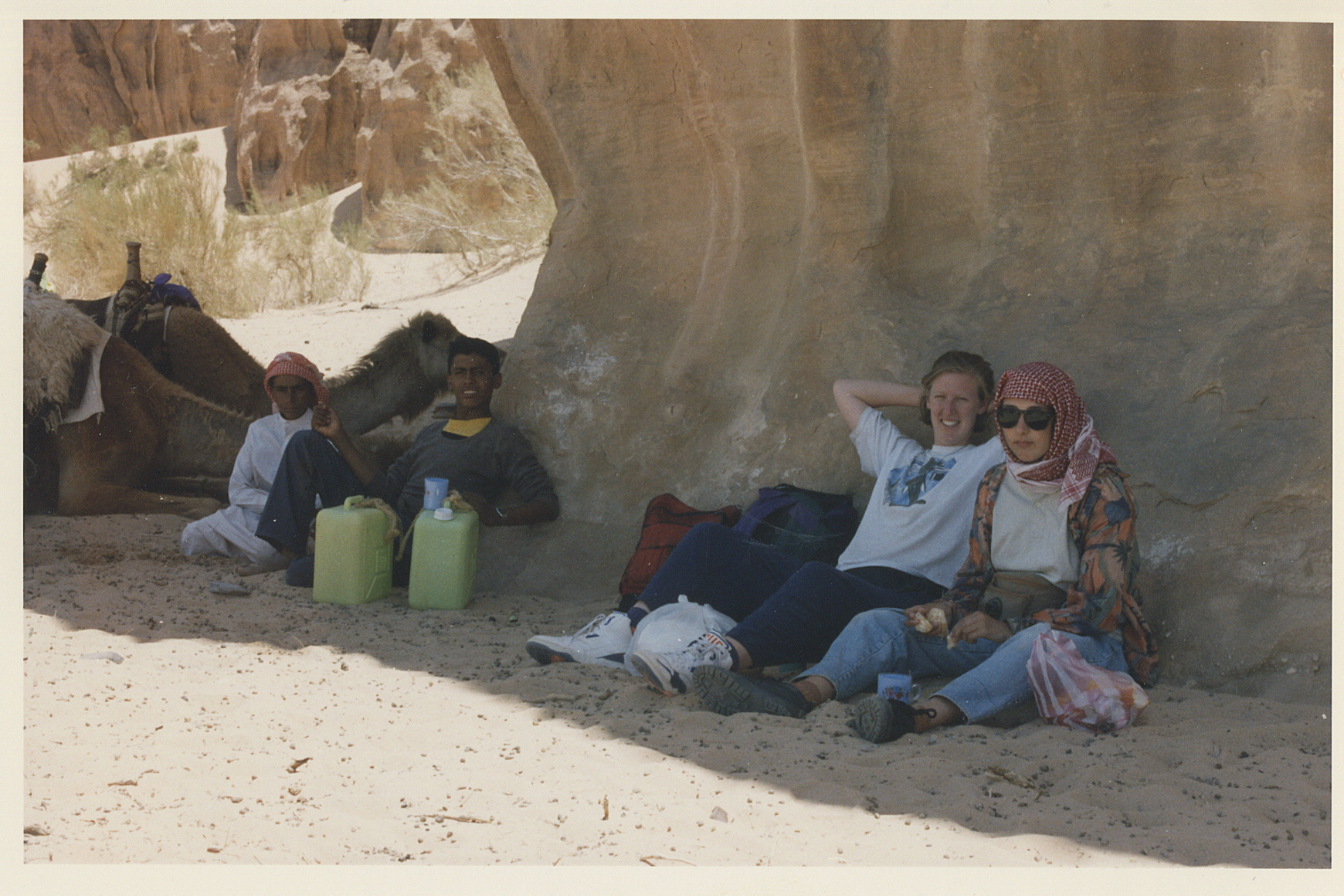
Melissa in the desert.
She was a daring, courageous soul who refused to compromise her values, lived for nearly a decade as a single woman in the Middle East, took her horse over jumps taller than I am, was one of the most loyal, loving friends and lived with cancer for 5 years.
It seemed only fitting to leave her bodily remains near a trail that is infrequently traveled.
In a place of solitude and silence where, now that she was through with it and the medical students were done with it, her body (ashes) could nurture new growth in wilderness.
In the place she loved most of all.
This is my story, tell me yours! How have you honored a loved one?
Leave me a comment below.
And sign up to get my weekly blog and other info.
3 Simple Tools to Develop Healthy Habits
I used to hate exercising. To me it was punishment. I exercised because I had to. I'd eaten too much and had to run or bike to counteract my inability to manage what I was eating.
When I released myself from my eating disorder I decided I had a free pass. I was now thin so I NEVER had to exercise again! I pretty much stopped for years, maybe even a decade. But because I didn't exercise, I had some physical side effects. The most notable one was head aches. One day my husband suggested that perhaps my neck muscles needed strengthening to hold my head up better.
What? Exercise?
I used to hate exercising. To me it was punishment. I exercised because I had to. I'd eaten too much and had to run or bike to counteract my inability to manage what I was eating.

When I released myself from my eating disorder I decided I had a free pass. I was now thin so I NEVER had to exercise again! I pretty much stopped for years, maybe even a decade or more!
But because I didn't exercise, I had some physical side effects. The most notable one was headaches. One day my husband suggested that perhaps my neck muscles needed strengthening to hold my head up better.
What? Exercise?
I tried it. Did some weights to build up my shoulder muscles and neck. Sure enough my headaches started going away.
My husband loves to exercise and he was always touting the importance of it for health reasons. I'd want to go with him but had so much resistance. I couldn't get out of bed. I was too tired. I ...
That's when I had the recognition that my view of exercise had always been associated with pain.
Right about this time, I hit 40 and started to realize that I needed to exercise for health reasons.
But because exercise always had that negative spin, it didn't feel fun. It was a requirement, a duty, a have to.
After I made the exercise=punishment realization, I knew I had to change my associations.
I had to create positive experiences and memories of exercise so that I'd want to go out for a run instead of dragging myself kicking and screaming.
I consciously talked to myself about it. "I like exercising. I feel so good when I exercise. It gives me energy. I'm good at this. It's a way to nurture my body."
Soon I was exchanging those old beliefs with new ones. Now I exercise 4-5 times a week. Not because I need to lose weight but because I feel so much better when I do it.
And exercise is a healthy habit.
So how do we shift ourselves out of old thinking that no longer works for us into making better, healthier choices?
The first step is the recognition.
For me it was that I had always associated exercise with punishment. What is it for you? Do you have to go to work? Do you have to mow the lawn? Can you identify what is behind the have to?
The second step is deciding that you want to change your relationship with an activity.
We do this with our beliefs and our words. In my example, I did it by reframing how I viewed exercise, how I talked about it and that helped me create new associations and beliefs. What habit would you like to shift? How can you change your language around it to better support you?
The third step is to do it and be positive.
So I went for a walk or a run, did push ups or an abs workout and tried to be enthusiastic about it. I also totally praised myself afterwards for doing it. "Good job! Awesome workout!"
Our habits stem from our beliefs, Our beliefs are formed by our words, our thoughts and our actions. By being positive while exercising, I created new memories to replace the old ones.
What habit would you like to transform today?
Use these 3 simple steps to help you do that.
Tell me about it by leaving a comment below.
And if you aren't already signed up, join our community today!

Is This Really the World of Dating?
My friend Heidi posted a link to a Huffington Post article, My “Naked” Truth yesterday. It's Robin Korth’s account of dating a man who enjoyed her “head and heart” but not her body.
He told her he couldn’t get turned on by her physically because she was “too wrinkly.”
After reading the piece, I found that I couldn't stop thinking about it.

My friend Heidi posted a link to a Huffington Post article, My “Naked” Truth yesterday. It's Robin Korth’s account of dating a man who enjoyed her “head and heart” but not her body.
He told her he couldn’t get turned on by her physically because she was “too wrinkly.”
After reading the piece, I found that I couldn’t stop thinking about it.
First it just made me sad that this is where we are in the United States in 2014. That despite all of our technological advances we are still so emotionally immature towards one another as individuals and as one gender relating to another. It also implies that we are woefully unaware of the power of words to harm one another and the pain that judgment brings.
Brené Brown tells us, the primary shame trigger for women is our bodies.
We women are all intensely aware of what we look like and are usually our own worst critics. So for Dave (the guy in the article) to not understand how hurtful his words and rejection of Robin’s body were to her is just plain stupid.
As my husband said to me after I read him the article, this is about objectifying women. Wanting the woman to live up to an image he has rather than the ability to actually see, love and accept what is right in front of him.
It made me sad too that this is the world of dating for older women.
I was reminded of some of the comments my father used to make about women. “She’s too overweight” or “she looks my age.” He often dated women decades younger than he was. Perhaps they were more nubile but what did they have in common?
Then one day I wondered, “What was he bringing to the table?”
The spare tire encircling his waist, his gray, balding head, wrinkles. Why was it okay for him to be imperfect, old, saggy and not her? It shouted of being a double standard. Yet most women are used to this and maybe that’s the worst part of all. That, having been objectified or pummeled by societal expectations of beauty for so long, we think it’s okay for men to have false expectations.
Fortunately, Robin provides us with a silver lining in her article.
Instead of accepting Dave’s words and allowing herself to be shamed, she took her power back. And she’s absolutely right. We all deserve to be loved exactly for who we are, what we look like clothed and naked, and for all of our opinions, beliefs and quirks.
That love starts with us, with us accepting ourselves exactly as we are from head to toe.
Read Robin's article and tell me what you think! (click here)
If you’re a woman, have you ever had something similar happen to you?
If you’re a man, how can you relate to what Robin experienced?
Leave a comment below! Let’s start a dialog.
Sign up to receive regular news from me! It's free!

Wait for the Answer?
I don’t know about you but when I have a question or am unclear about something, I always want it resolved immediately. Yup, you can call me impatient. I want to know, to be clear, sure, certain.
Part of why I’m like this is because I’m an action oriented person and can only act once I know what to do. When I don’t know it’s like being on an airplane circling the airport in a holding pattern. I don’t like that feeling on in-action, confusion, or lack of clarity. It is uncomfortable.

I don’t know about you but when I have a question or am unclear about something, I always want it resolved immediately. Yup, you can call me impatient. I want to know, to be clear, sure, certain.
Part of why I’m like this is because I’m an action oriented person and can only act once I know what to do. When I don’t know it’s like being on an airplane circling the airport in a holding pattern. I don’t like that feeling on in-action, confusion, or lack of clarity. It is uncomfortable.
Lately, though, I’ve been toying with this idea of allowing for space.
What I mean by that is to ask a question and be okay with not immediately knowing the answer, being okay with allowing room for possibility and for answers to percolate up rather than be instantaneous.
It’s almost like being more patient with life, allowing it to unfold rather than be pushed along.
I suppose being comfortable with space means that I’m okay with uncertainty or not knowing. And when I think about it from that perspective, it’s about trusting. Trusting that an answer will be revealed. Maybe not on my timeline or schedule, maybe not even my predicted outcome but an answer that is divinely perfect.
What’s interesting is that as I allow myself to relax into that space, I find ironically, that I’m less anxious!
And I actually forget I’ve even asked a question! It’s like being in a space where life is okay no matter what. Where I don’t have to be so vigilant and work so hard. Where I can relax and enjoy myself more, knowing that it’s all fine.
As I think more about this idea of space, I realize that here –in the in between place- is where all the answers lie, where creativity lies, the place of pure potential. And thinking about that makes me feel excited to be in that space- the birthplace of creativity.
So instead of feeling worse, anxious or stressed, I actually feel more excited, more alive, more in harmony with life and divinely guided. Who would’ve thought!
What do you think? Are you willing to allow for more space in answering your questions?
Let me know your thoughts by leaving me a comment.
And as always, sign up to receive my emails, free!

Three Things of You
When I was in my early 20s, I was walking down the street one day when an interesting idea came to me. I’d been contemplating self evolution (as usual) and had the realization that each of us has 3 components to our beings:
The physical, the intellectual and the emotional (now I would add a 4th- spiritual).
Of these three aspects of self, we all have an affinity toward one as the area in which we feel most comfortable. So, for example, an athlete who works out daily and relishes in his routine is clearly most at ease in the physical realm.

When I was in my early 20s, I was walking down the street one day when an interesting idea came to me. I’d been contemplating self evolution (as usual) and had the realization that each of us has 3 components to our beings:
The physical, the intellectual and the emotional (now I would add a 4th- spiritual).
Of these three aspects of self, we all have an affinity toward one as the area in which we feel most comfortable. So, for example, an athlete who works out daily and relishes in his routine is clearly most at ease in the physical realm.
I, on the other hand, am most relaxed in the emotional realm and love to talk about how I feel, to understand what I’m sensing and process that. Lots of people prefer the intellectual realm – those who love ideas and enjoy analysis and debate.
We all have one area of preference, then a secondary one in which we are also at ease or, at the very least, neutral and then one that we may try to avoid because it feels so incredibly uncomfortable.
For me, my painful realm is the physical.
And at 24 or so, when I had this realization, I was struggling with my weight and hating my figure. My body was the enemy, why would I even want to be in it? It was fat, bloated, uncomfortable, embarrassing. I tended to just ignore it.
After I started thinking about these three aspects of self, I realized that in order to be balanced, I had to move into the area of discomfort- for that is where the opportunity for growth lies- AND in doing that we heal ourselves.
You can imagine that I did this kicking and screaming.
The last thing I wanted was to be in my body, to make it real and feel it. But I did.
Perhaps because I was willing to do this it helped me let go of my eating disorder, I don’t know. But what I do know is that being in my body changed me.
It’s kind of a funny thing. All the time I thought it would be scary and painful but once I made the commitment to do it, (it was a gradual process) my life indeed became more balanced.
I was able to actualize ideas and thoughts rather than just have them spin around and around in my head.
Being in my body grounded me and allowed me to be even more present.
Twenty years later I’m definitely more balanced and have worked hard over that time to be in my body, do physical exercise and engage on a physical level.
I still work at it. My mind plays tricks on me and the wall of resistance is there. I’ve just gotten better at not listening to it and doing it anyway.
Here’s a great example. In my early 20s, I wanted to exercise to help me lose weight but I mostly didn’t. I thought about it all the time but just never actualized it. One day my father said to me, “you’d already be done with your run if you’d just gone and done it instead of constantly thinking about it.”
But that’s where I was then. Now, I just go and do it. I still don’t relish it, I still have to force myself BUT exercise helps me be in my body. I feel so much better emotionally too when I exercise (who would’ve thought!)
Think about yourself. What is your primary and secondary area of strength and which one is your challenge area?
What is the one you avoid out of fear or old beliefs? Maybe you hear stories in your head like, “I’m not smart” or “I’m a bad student.” Maybe it’s “People always tell me I’m cold or heartless.” Or perhaps it’s “Hike that hill? No way, I’m terrible at physical exercise.”
Here’s an email message I got the other day that inspired this blog:
One way to work on yourself is by being present in the body. Another way is by expanding the heart. A third way is by quieting the mind. The wise person finds a way to work on all three at the same time. (Understanding the Enneagram, 327)
Isn’t that what I was just saying?
Identifying your area of strength and also what to work on can help you better understand yourself. Moving into the discomfort even though it feels scary at first, is so rewarding and ultimately incredibly balancing. As you brave it, you’ll find yourself feeling even more like you!
So try it and let me know how it goes. What’s your area of strength? Tell me about it in a comment below.
And, as always, if you don’t get my emails, sign up!

Keeping Yourself on Track
It’s so easy to look at other people and feel like they’re way more motivated than I am. Other people seem to get so much done while I can often feel like it takes me ages. Ever feel like that?
Over the years, my self-motivation has definitely ebbed and flowed. There’ve been times when I’ve been really unmotivated. Mostly during those times I was an avoider- checking out and not wanting to deal with my life- with the stress and with pushing through.
It’s so easy to look at other people and feel like they’re way more motivated than I am. Other people seem to get so much done while I can often feel like it takes me ages. Ever feel like that?

Over the years, my self-motivation has definitely ebbed and flowed. There’ve been times when I’ve been really unmotivated. Mostly during those times I was an avoider- checking out and not wanting to deal with my life- with the stress and with pushing through.
Nowadays I really work on finishing what I’ve started. Why? Because I had the realization that it isn’t until I actually finish something that I have a breakthrough. So if I say yes, I do my best to accomplish it.
In thinking about staying on track, I realized there are a few strategies I use that might help you! Here are some of the ways I keep myself motivated – even when I don’t want to!
Shakti’s Top 5 Strategies for Staying Motivated
1. Schedule Yourself & Make Sure to Take Breaks
These days I schedule my whole week and what I plan to do each day. Some mornings I look at my list and think, “ugh, I don’t really want to work on my website today.” But then, because I’ve scheduled it, I start doing it and soon my resistance clears and I find I’m enjoying myself! I can’t work for too many hours in a row without taking a break though. Not only do my legs need a re-adjustment but so does my brain. Breaks help keep the creative juices flowing.
2. Be Realistic About What You Can Get Done
When I first started scheduling myself, it was a little like lesson planning. I always overdid it. Fortunately I knew ahead of time that I might not get everything done so I wasn’t upset- more like –“oh, so this is how much I can reasonably get done in 4 hours.” Now I schedule more realistically.
3. Go the Distance
Think marathon, not sprint. Many people start strong only to peter out and then drop out. When I want to quit, I often think about Aesop’s fable, The Tortoise and the Hare. The tortoise was so slow and plodding but won the race. My inclination is to be more like the hare and run and leap and fly and then crash. Knowing this about myself, I recognize when I have creative bursts and take advantage of them just as I give myself down time when I need it but I’m always on the look out for that finish line. It helps me get back up- knowing that’s the goal- and I’m gonna get there.
4. Ask for Help
When you feel like you’re flagging or down, discouraged or wanting to quit- reach out. There are sooo many people around you all the time who love and support you and truly want you to succeed. So don’t be afraid to reach out. Friends can lend moral support, help with chores or provide ideas. Colleagues can provide guidance and assistance. We often forget that we are not alone- all we have to do is ask and it is given.
5. Celebrate the Small Victories
A successful strategy I used while going through social work school, was to focus ONLY on what was right in front of me – my current 2 or 3 classes- and their work load. This helped me avoid the pitfall of overwhelm if I looked at everything I would have to do. Chunking it down to 12 weeks made the workload doable and felt manageable. When a semester was over, I celebrated! And before I knew it, I was done!
Alright, so there’s my 5 tips. Let me know if they help YOU!
Leave me a comment BELOW. Tell me what helps you stay motivated.
And if you liked what you read, sign up- it’s FREE!

The Ugly Twins – Guilt & Shame
Probably two of the most painful culprits in the emotional arsenal are guilt and shame. These two can seriously wreak havoc on us. It wasn’t until I read Brené Brown's work that I fully understand the difference between them AND how to let go of one and positively utilize the other.
Guilt is the feeling we have when we know we’ve done something wrong or hurt another. We feel bad about our actions. Perhaps I yelled at my daughter in an unkind way or I forgot to leave a tip for the waiter. My action results in me feeling guilty.

Probably two of the most painful culprits in the emotional arsenal are guilt and shame. These two can seriously wreak havoc on us. It wasn’t until I read Brené Brown's work that I fully understand the difference between them AND how to let go of one and positively utilize the other.
Guilt is the feeling we have when we know we’ve done something wrong or hurt another. We feel bad about our actions. Perhaps I yelled at my daughter in an unkind way or I forgot to leave a tip for the waiter. My action results in me feeling guilty.
Guilt can act as a reminder for right or wrong.
It’s like an internal morality indicator, letting you know if something you’ve done goes against your value system. Brené Brown writes, “[Guilt] is an uncomfortable feeling, but one that’s helpful. The psychological discomfort, something similar to cognitive dissonance, is what motivates meaningful change.”
Overall, when we experience guilt, it can propel us to make amends and change our behavior and so is seen as a potentially positive force.
Obviously taken to the extreme, guilt can be harmful and is especially destructive if we attempt to “guilt” another person, as in making someone feel bad if they don’t do what I want them to do.
Shame, on the other hand, is the internalization of wrongdoing with the interpretation not that my actions were wrong (that’s guilt) but that I’m a bad person because I’ve done this – (yelling, stiffing the waiter.) Then the berating, negative self-talk ensues. “How could I have done that? I’m so stupid, bad, a terrible mother…”
According to Brown, “…shame corrodes the very part of us that believes we can change and do better…” Shame harms us in that moment and her research indicates that, “shame is highly correlated with addiction, violence, aggression, depression, eating disorders and bullying.”
Shame is the voice of “I’m not good enough. I’m not lovable.”
It is who we become when we feel not enough. It is the choices we make to escape, check out, hurt ourselves or hurt others.
Because we’ve all been shamed in our lives and believed it, we now walk around feeling less than, feeling flawed, feeling like we are works in progress instead of wholly loved, talented, incredible beings.
As Brown notes, “Shame is so painful for children because it is inextricably linked to the fear of being unlovable. For young children who are still dependent on their parents for survival- for food, shelter and safety- feeling unlovable is a threat to survival. It’s trauma. I’m convinced that the reason most of us revert back to feeling childlike and small when we’re in shame is because our brain stores our early shame experiences as trauma, and when it’s triggered we return to that place.”
Now that we know more about shame and guilt, we can choose to listen to those old stories about who we are or make new ones. In the 25 years I’ve been working on myself, I see more and more clearly how simple it actually is. In fact, it comes down to one concept – are you ready?
Self-acceptance.
That’s it!
All the words of criticism I heard growing up made me think I wasn’t enough and hell, I wasn’t ever going to be enough. But really, whose words were those? Those were the words my father said to himself, my mother said to herself, my stepfather said to himself, and on and on and on. It really was never about me, I just mistakenly thought it was.
Now I know it isn’t.
As one of my favorite teachers, Dr. Robert Holden says, “no amount of self-improvement can make up for a lack of self acceptance.”
So there it is – self acceptance is the shame-buster.
It starts right here, right now by saying to myself, “Shakti, I totally love and accept you. Right now, just as you are. Just as I am.”
Okay, now it’s your turn. Let me know how it goes.
How have you experienced guilt and shame? Share with me by leaving a comment below!
And join our community- get our emails - FREE Sign up today!

Enough is Enough!
Growing up in a family where conditional love reigned, it was easy to never feel good enough. My job was to be perfect and then I’d receive love. My sister was the "problem child" so consequently, the message I got was that I wasn't allowed to be in need, melting down or falling apart. I had to be together so I became a master at pretending I was while underneath felt totally insecure and inadequate.
Growing up in a family where conditional love reigned, it was easy to never feel good enough. My role was to be perfect, then I’d receive love. My sister was the "problem child" so consequently, the message I got was that I wasn't allowed to be in need, melting down or falling apart.

I had to be together and became a master at pretending I was when underneath I felt totally insecure and inadequate.
The way I navigated around New York City then was a good analogy for how I managed my life as a teen and young adult. I’d get off the bus at the Port Authority which, in the 1980s, was pretty shady. The area was still chock full of XXX movie theaters, prostitutes, petty criminals and other nefarious types. I’d walk confidently even when I was lost. Part of me knew it was a good coping mechanism, to act like I knew where I was going. Another part of me was simply used to donning the mask-“I know what I’m doing” even when the scared little girl underneath didn’t.
Because of the role I chose to play as a child, I never felt good about me, that I was enough just the way I was.
I had to be who you wanted me to be in order to be loved. I had to be thinner, more organized, responsible.
It felt like there was a hole in the center of me, a hole I was always trying to fill up – with food, with drugs, with boys, with travel. But no matter how much I tried, it was still there until I finally surrendered to God and to me, to accepting me just for me. As I did this, the hole was suddenly filled up with love, love of myself.
Or put another way, the recognition that I was indeed loveable just for being me.
This process took a while and pressed me to let go of a lot of my old beliefs about myself, my family and how to give and get love. And, like everything, lack still rears its ugly head from time to time. Especially on days when I don’t feel like doing anything (ever have one of those?) The voice inside says, “don’t be so lazy. Do something. Be productive. At the very least go for a run or water the plants…”
Those moments are opportunities to catch myself and remember my new orientation.
I can stop and say, “Can you see what’s going on, how you’re talking to yourself? How does that feel? Is it okay just to be who you are right now, to accept yourself just the way you are right now?”
And to remember that I’m enough just the way I am.
Yesterday I was in the supermarket waiting to check out and was perusing the magazine headlines when my eye came across More. I smiled remembering a conversation I’d had with a friend a few years ago. She’d said, “Why isn’t there a magazine called Enough?” As the words left her mouth, I knew she was right. Because not only do we get messages of inadequacy from our family we get way more from society.
It tells us we need more- more money, more clothing, more furnishings, more beauty, more Botox, more, more, more. When is it enough?
My answer is when we decide.
From decades of self searching, healing and studying, I’ve realized that it all comes down to one simple thing, self-acceptance. The more that I love and accept myself, the more life opens to me, love is attracted to me and I am connected to the divine energy of the Universe.